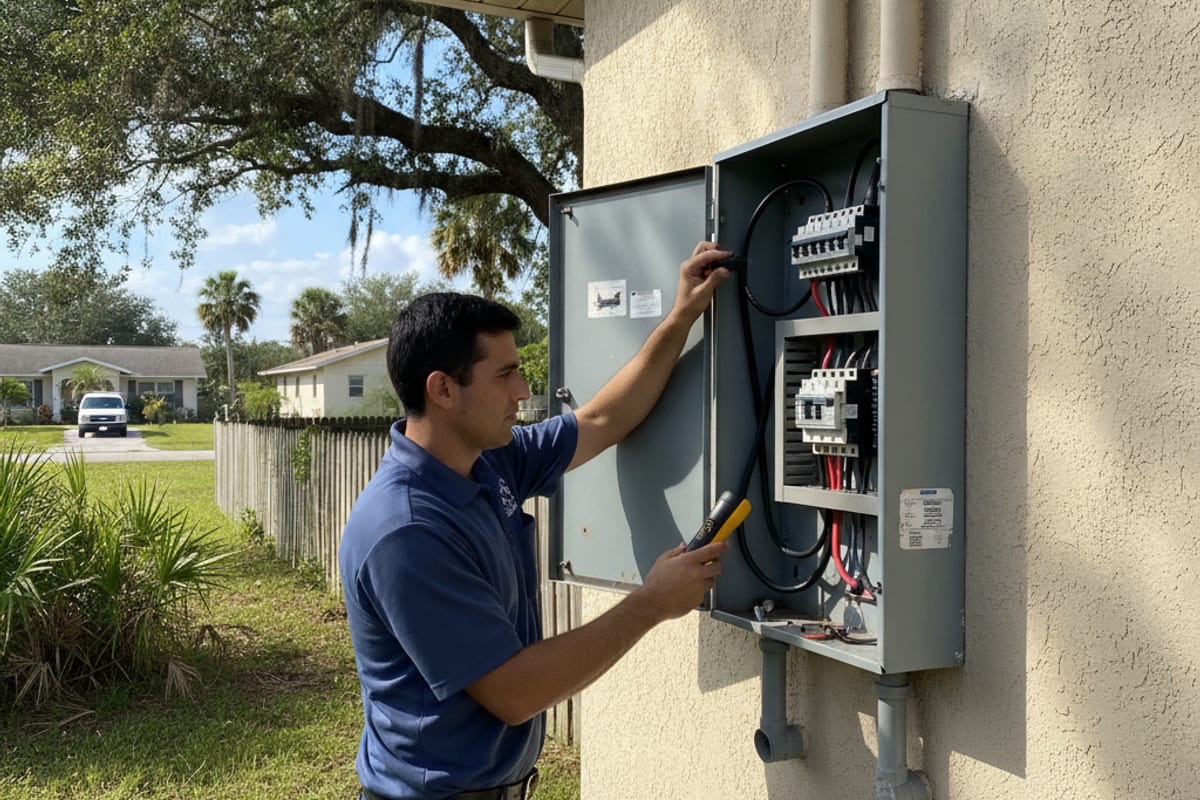
Bloomingdale sits in the heart of central Hillsborough County, where the landscape shifts between older established neighborhoods and newer suburban growth. Homes here range from 1970s concrete block ranches with original aluminum wiring to modern subdivisions built in the past decade with 200-amp service by default. The area’s character is distinctly rural-suburban: single-story homes on spacious lots, live oaks with Spanish moss, scattered commercial zones, and wide open stretches of undeveloped land dotted with palmettos and pines. The Florida heat and humidity are relentless, which means air conditioning runs hard most of the year, and electrical systems need to handle that load reliably.
You need an electrician who knows Bloomingdale’s mix of old and new housing stock, understands Hillsborough County permitting, and delivers straightforward answers without guesswork. Whether you need a panel upgrade to handle modern electrical demands, a same-day repair for a burning smell near your breaker box, or a full electrical installation project, the right contractor explains what’s needed and does it correctly.
Bloomingdale’s mix of older and newer homes
Bloomingdale’s housing stock tells a story of two Florida eras. Neighborhoods around Gibsonton and Riverview read as established, with predominantly 1970s and 1980s concrete block construction, 100 to 150-amp panels, and wiring that was built for basic household loads. Many of these homes have original aluminum branch circuits, which creates specific fire risks if connections aren’t maintained properly. The same neighborhoods also see Florida’s familiar aging patterns: salt air corrosion on outdoor connections, humidity finding its way into panels and outlets faster than homeowners expect, and AC systems that run virtually year-round.
Moving eastward into newer Bloomingdale growth areas, homes built after 2005 typically arrive with 200-amp service standard, modern code-compliant panel placement, and circuits designed for today’s loads. These homes still face Florida’s moisture and electrical demands, but the infrastructure starts ahead. Mixed-use corridors near US 41 add commercial electrical needs: retail, office spaces, and light industrial work all require reliable power with stricter inspection schedules.
Common Bloomingdale electrical problems include older homes unable to handle modern AC plus summer loads without breakers tripping, panels deteriorating from humidity and moisture, outlets failing in clusters (a sign of a failing breaker or damaged circuit), flickering lights that point to a loose connection at the main panel, and pools or hot tubs with incomplete electrical bonding.
When you need electrical help right now
A single dead outlet is usually a fast fix: bad outlet, tripped GFCI, or a blown breaker. Call and get it handled same-day. A whole room losing power points to either a dead breaker, a tripped main, or a wiring problem in that specific circuit. That’s when you stop troubleshooting and bring in a licensed electrician.
Burning smells near the panel, visible rust inside the breaker box, breakers that are warm to the touch, or a low constant hum are fire hazards. Don’t wait. A licensed Bloomingdale electrician can diagnose the issue and fix it today before anything dangerous develops.
Flickering lights throughout your house usually mean a loose connection at the main panel, the meter can, or somewhere on the utility company’s side. Dimming every time the AC kicks on signals a capacity problem: your panel handles normal loads fine, but struggles when high-draw devices run at the same time. Neither is an emergency, but both need someone who understands load calculation and can trace power from your service entrance to the exact problem.
Panel upgrades and what they actually solve
A 100-amp panel in a 1975 Bloomingdale home might work fine for basic household loads. Add a modern air conditioning system running hard eight months a year, add an EV charger for a couple hours daily, add a standby generator for hurricane season, and suddenly your panel is at its limit. A panel upgrade from 100 to 200 amps gives you real breathing room and opens up options without rewiring your entire house later.
Florida Building Code requires panels to have capacity for future additions. A good electrician sizes your upgrade assuming you’ll add things over the next decade, which costs a bit more upfront but saves thousands if you ever actually need that capacity.
Permits are not optional
Any electrical work beyond a simple outlet replacement needs a Hillsborough County permit. Any electrician suggesting you skip the permit to save time or money is showing you something important about how they work, and it’s not good. Unpermitted work shows up at home inspection, sale time, or when your homeowner’s insurance needs to deny a claim related to that circuit.
A licensed Bloomingdale electrician pulls the permit, schedules the inspection, and handles all the paperwork. That adds a few days to your timeline but protects you completely. It’s the right, normal way to do electrical work.
Lightning, surge protection, and hurricane readiness
Central Florida gets more lightning strikes than almost anywhere in the continental US. A single lightning hit can destroy expensive appliances, HVAC systems, and electronics instantly, even if the strike wasn’t directly on your house. Surge protection at the main panel gives you real protection instead of relying on outlet-level suppressors, which don’t catch everything.
If lightning’s been close, if you’ve seen appliances fail mysteriously, or if you’re running equipment you can’t afford to lose, whole-home surge protection is a genuine upgrade. If you’re worried about extended power outages during hurricane season and you can afford the investment, a whole-home generator is a bigger project but worth serious consideration.
Finding an electrician you can trust
Start with the license. Any electrician working in Bloomingdale should hold a Florida Electrical Contractor license (EC). You can verify it online in minutes at the Florida Department of Business and Professional Regulation website. That’s not paranoia, that’s smart.
Ask whether they pull permits and handle inspections. Good answer: yes, every job. Bad answer: depends on the job, or we can work around it. Those words signal problems later.
Ask for a written estimate that shows what’s included, what’s excluded, and what the cost is. A contractor giving you a verbal number and expecting you to decide on the spot isn’t operating professionally.
Ask about warranty. One year labor warranty plus manufacturer’s warranty on parts is standard. Anything less is worth questioning.
What a service call looks like
A licensed Bloomingdale electrician will show up on time, discuss the problem before touching anything, explain what they’re seeing in plain language, propose a fix with cost, and ask permission before starting work. They won’t discover new problems mid-job and surprise you with add-ons without talking through it first.
They’ll pull a permit if needed. They’ll clean up after themselves. They’ll test their work before they leave. And they’ll give you documentation of what was done.
Same-day emergency versus scheduled appointment
Call today for breakers that won’t reset, outlets that suddenly stop working, burning smells, or anything involving the panel. Those are safety issues.
Upgrade planning, new circuit installation, and fixture replacement can wait for a regular appointment. Both are important, they’re just different urgencies.
FAQ about Bloomingdale electricians
How much does electrical repair cost in Bloomingdale? Service call fees run 75 to 150 dollars in Hillsborough County, and actual repair costs depend on what’s wrong. A breaker replacement might be 200 to 400 dollars total including the service call. A panel upgrade could run 3000 to 6000 dollars depending on the existing panel, what’s being upgraded, and permitting complexity. Ask for a written estimate before you commit.
How long do electrical repairs take? A simple outlet or switch replacement takes an hour or two. Breaker repair might take an afternoon. Panel upgrade or full circuit addition could take a full day or stretch to two days if permits are involved. A good electrician gives you a realistic timeframe when they give you the estimate.
Do I need a permit for a new outlet? Yes. Any new circuit work, new outlets, new fixtures, or service changes need a permit. Replacing an existing outlet with an identical outlet sometimes skips the permit requirement, but if you’re adding or changing circuits, a permit is required. A licensed electrician handles this automatically.
What’s a GFCI outlet and why should I care? Ground-fault circuit interrupter outlets cut power instantly if they detect a fault, protecting you from shock in wet areas like kitchens and bathrooms. Florida code requires them in specific locations. They’re standard protection now, and a good electrician makes sure you have them where code requires them.
What if my home has aluminum wiring? Aluminum wiring in homes built in certain years creates specific risks, especially at connections where it meets copper. If your Bloomingdale home has aluminum branch circuits, a licensed electrician should inspect the connections and possibly recommend upgrades or special connectors to prevent fire risk. It’s not a deal-breaker, but it’s something to address deliberately.
Can I do electrical work myself? Small things like replacing a switch cover or outlet cover plate are fine. Anything involving the panel, new circuits, adding load, or working inside walls should be done by a licensed electrician. DIY electrical work is how fires start.
Next step
If you’re in Bloomingdale and you need electrical work, call us at (813) 850-0320. We’ll connect you with a licensed contractor who operates the right way, pulls permits, explains the work, and stands behind it. No surprises, no shortcuts, just straight answers and solid service.