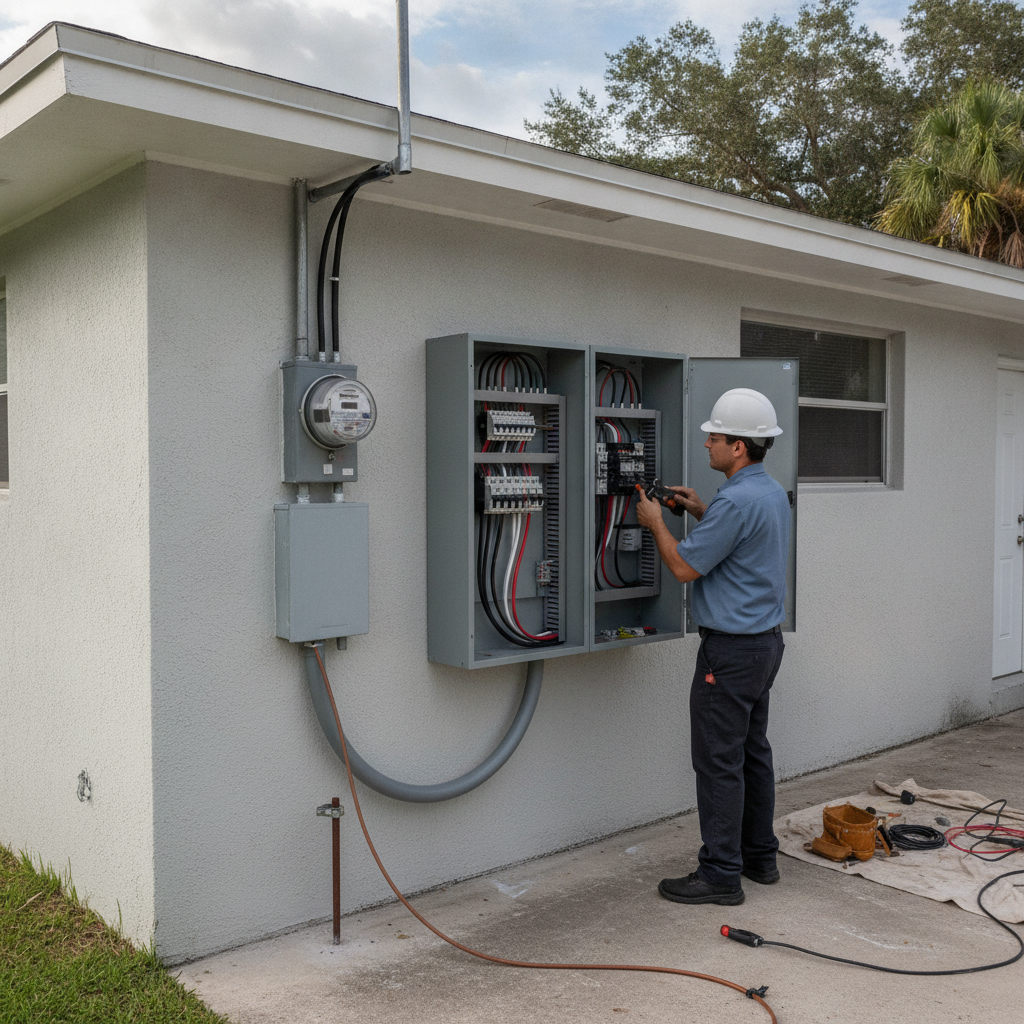
A 200-amp service upgrade is the utility-side job of bringing a larger feed into a Tampa Bay house. The panel on the garage wall is only one piece of that path. The meter socket, the riser, the weatherhead, and Tampa Electric’s connection at the load-side terminals of the meter all have to match the new rating, and a licensed electrician coordinates that work with the utility. Swapping the breaker box by itself is a different scope.
Panel swap vs a service upgrade
A panel swap replaces the breaker box. A service upgrade also changes the conductors and equipment that bring utility power to that box.
The panel is house-side gear: bus bars, the main breaker, branch breakers, and the empty spaces those breakers occupy. Service capacity is the size of the feed from the street. You can hang a new enclosure that looks ready for 200 amps and still be fed by a smaller service if the meter, the mast, and the service conductors never changed. Circuit space and service capacity are two different problems. The electrician has to name both at the property.
This search usually starts with a new load. A heat pump. A pool pump. A Level 2 charger on the wall of a Riverview garage. A standby generator ahead of hurricane season. A Level 2 charger uses 240 volts. The Department of Energy’s home charging page notes that the vehicle, daily range, and parked time affect the right charging setup, and that the electrician evaluates electrical capacity. A charger does not, by itself, prove the service has to grow to 200 amps.
A panel upgrade is the right conversation when the bus is full, the enclosure is the limit, or the main is the weak point, and the existing feed already supports the calculated load. A service upgrade is the right conversation when the feed itself is the limit. Tampa Electrical Pro matches homeowners with independent licensed and insured electricians. Those electricians run the load calculation on the actual house. A build year and a neighbourhood do not establish the service size sitting on the wall.
This site publishes a $2,500 to $4,500 range for a 100 amp to 200 amp panel upgrade. That is a site-published band, not a Tampa average and not a contractor’s quote. The selected contractor sets the price after inspecting the property. Treat that band as panel-upgrade scope. Once the meter socket, the riser, and the weatherhead are in the work, more hardware and more utility coordination are in play, so the panel-only figure is the wrong number to treat as a turnkey total.
For the charger path, see EV charger installation. This site’s published charger-install band of $1,200 to $2,000 assumes the existing panel already has the capacity. It does not cover a job that also grows the service. For backup power with transfer equipment that isolates the house from the utility, see whole-home generator. A standby generator supplies backup power. It does not add utility load by itself.
| Job | What actually changes |
|---|---|
| Panel swap | The breaker enclosure, the main, and the branch spaces. The meter, mast, and service size stay as they are. |
| Service upgrade | The feed size, plus the matching socket, riser, weatherhead, and usually the panel so the house-side gear matches the new rating. |
TECO and the meter socket
For a Tampa Electric customer, the meter socket is the customer’s equipment, and the company picks the type and the location.
Tampa Electric’s retail tariff says the customer must provide a self-contained meter socket or meter enclosure on the premises. The type comes from the company’s approved list. The location is determined by the company. For a new installation, and for relocation or upgrade of existing metering equipment, Tampa Electric designates that location. Meters for individual residences go outdoors on the front or adjacent side walls of the building.
The tariff’s exemplified case for a single self-contained meter is a 200 ampere socket on the outside of the building, at a company-specified location, with a rigid metal conduit system from the bottom of the socket to company specifications. That is an example of one point of delivery. It is not a rule that every Tampa Bay home has 200-amp service, needs it, or must upgrade to it.
Self-contained meter socket enclosures on Tampa Electric’s system are limited to 400 amperes or less. That is a metering limit. It is not a panel-sizing recommendation, and it is not a reason to skip a load calculation.
On height and working room, the tariff is specific. A clear space of 48 inches stays in front of meters and metering equipment for reading and testing. The center of the meter sits not less than 4 feet 6 inches and not more than 5 feet 0 inches above finished grade. The socket gets at least three inches of clearance in all directions from any adjacent switch or device unless the company approves otherwise before installation. Those figures are Tampa Electric tariff rules for metering equipment.
The socket has to be fastened securely, square and plumb. Wooden pegs are not an approved mount. Meter sockets and customer electric service risers are not attached to Tampa Electric poles. Customers are not allowed to make connections to or disconnections from Tampa Electric equipment. Connection and disconnection work is Tampa Electric personnel unless the company authorizes otherwise. That is why a homeowner cannot “just swap the can” on a Saturday.
After a storm, Tampa Electric’s damaged meter equipment page splits the parts so you know who to call. Tampa Electric is responsible for storm-related damage to the electric meter and the service line. Customers are responsible for damage to the weatherhead, the riser, and the meter box. The meter box is where the meter is mounted and where it encases the cable connection to the breaker panel. That split is for storm-related damage. A rusted or burned socket in fair weather is a different conversation, and the tariff still puts replacement of a deteriorated socket on the customer. For the house-side half of that split, who replaces an electric meter box in Tampa walks the same boundary in more detail.
Tampa Electric also lists places meters and main switches will not be placed: transformer vaults, attics, bathrooms, bedrooms, display windows, laundries and other places subject to dampness or flooding, and garages where a meter may take vehicle damage, plus setbacks from doors, fuel tanks, and natural gas meters. An existing meter sitting in one of those spots is not, by itself, proof of a violation or a required move.
If the house is on Duke Energy Florida rather than Tampa Electric, those tariff sheets do not apply. The electrician still has to follow that utility’s approved equipment list and location rules.
What the job includes
A 200-amp service upgrade is a coordinated cutover, not a single box swap.
On the customer side of the ownership line, which Tampa Electric places at the load-side terminals of the metering equipment in that single-meter example, the electrician is looking at the meter socket, the riser, the weatherhead, the service entrance conductors, grounding, and the panel. The weatherhead is the rounded fitting that receives the service lines. The riser is the pipe that contains those lines and connects the weatherhead to the meter box. If any of those parts are undersized for the new rating, they come with the job.
Tampa Electric’s smart meters have remote service capabilities that help support many connection and disconnection requests without an on-site visit. That published capability does not mean a service upgrade is handled remotely, and it does not set a restoration schedule. Field work still happens around the socket, the drop, and the cutover.
Permit review follows the property, not the mailing city. A Largo address goes through Largo’s Building Division. Unincorporated Pinellas and specified partner cities go through Pinellas County’s building-department map. Temple Terrace has its own electrical applications. Inside Tampa, Plant City, and unincorporated Hillsborough, the reviewing office is the one that actually covers that lot. The licensed contractor confirms the permit and inspection steps with that authority. Tampa Electrical Pro does not pull permits. How electrical permits work in Tampa is the local walkthrough of that split.
Florida certified electrical contractors can work statewide. Registered contractors work within their authorized local jurisdictions. Specialty licenses have bounded scope. EC is not the only lawful category for this work, and not every person on the job personally holds a contractor license.
What moves the price, once you leave the panel-only band, is mostly access and matching hardware. A socket on a South Tampa stucco wall with a short mast is a different day than a long riser to a detached Odessa garage at the end of the lot. A relocation because Tampa Electric designates a new meter location is a different day than leaving the can where it is. Concealed routing, a pedestal, a trench, or a panel that also has to grow in circuit spaces all add labour. The reviewing authority sets its own permit fee. The contractor prices after seeing those conditions.
A charger on the far wall of a garage, with the panel on the opposite side of the house, is mostly a long 240-volt run. That run is not a service upgrade by itself. Portable cords on individual appliances are a different thing from connecting a generator to house wiring, which is unsafe as a backfeed. Direct backfeeding into house wiring is not a workaround.
If unexplained flicker, heat, arcing, or a burning odor is why you started searching, that is inspection territory, not a DIY sizing project. Tampa Electric tells homeowners not to repair electrical products unless they are qualified, and to have an electrician check a loose outlet or an appliance that keeps tripping a breaker. Leave the panel closed.
Common questions about 200-amp upgrades
How much does a 200-amp service upgrade cost?
This site’s published range for a 100 amp to 200 amp panel upgrade is $2,500 to $4,500. It is a site-published figure, not independent market evidence, and the selected contractor prices the actual job after seeing the house. A true service upgrade that also replaces the meter socket, the mast, and the weatherhead has extra parts, extra routing, and extra utility coordination, so the number moves with those conditions. The reviewing building department sets its own permit fee.
Can you upgrade to 200-amp service yourself?
No. On Tampa Electric’s system, customers are not allowed to make connections to or disconnections from Tampa Electric equipment. Meter sockets and customer electric service risers are not attached to company poles. The work on the house side is licensed electrical work. A handyman is the wrong category for a service cutover. Leave the meter seals alone.
Can a 100-amp service be upgraded to 200 amps?
Yes, that is a common scope, and it is exactly the band this site already publishes for panel-upgrade pricing. Whether a given house should take that step depends on the load calculation at the property, the condition of the socket and mast, and what Tampa Electric designates for the meter location if the metering equipment is being upgraded. The electrician reads the existing equipment. The age of a Lutz ranch or a Hyde Park bungalow does not establish that the service is 100 amps.
Is a 200-amp service upgrade worth it?
It is worth it when the feed is the limit on a real load you intend to add, or when the existing service equipment is deteriorated and already due for replacement. It is the wrong spend when the panel is simply out of breaker spaces and the service already covers the calculated load. A charger, a generator, and a heat pump are each a different load story. None of them is a blanket rule that every house needs 200 amps.
When to call us
Call when you are adding a large 240-volt load, when the meter can or mast is damaged, or when a load calculation shows the feed itself is the limit. The electricians we send are licensed and insured, and the contractor on the job confirms permit and inspection steps with the authority for that address. Call us at (813) 850-0320.