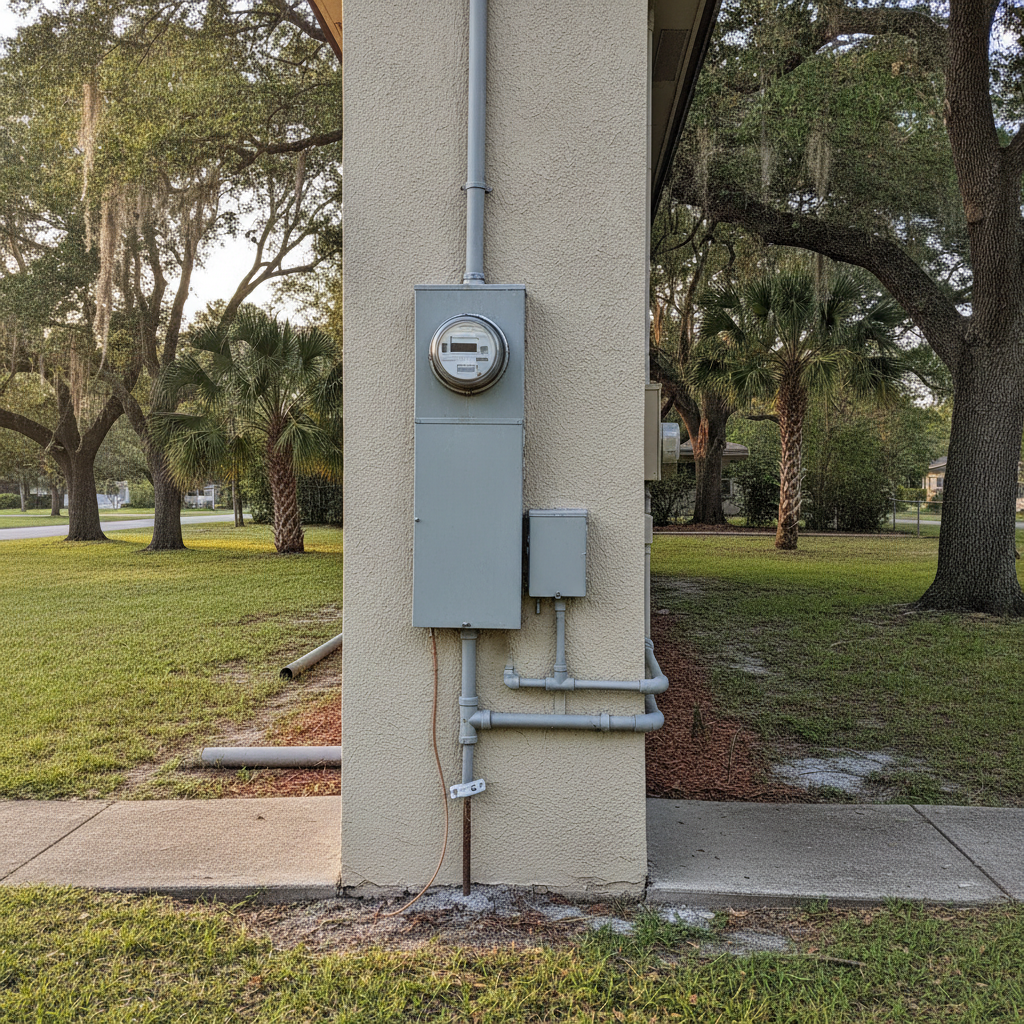
The gray box on a Brandon garage wall is doing three jobs at once. It is the main disconnect from the utility, the bus that feeds every circuit in the house, and the row of breakers that protect those circuits one at a time. A repair that fits a single dead breaker is the wrong move if the bus is packed or the service cannot carry another 240-volt load.
Panel repair vs a full replacement
Repair and replacement start from different findings on the equipment, not from a guess about the house. Brandon electrical panels get both kinds of work, and mixing them up is how a homeowner pays for a change-out that a listed breaker would have solved, or keeps a cabinet that cannot take the next circuit.
A repair is work on a panel that can still do its job. The usual version is one breaker that will not reset, will not stay closed, or will not trip when it should. The electrician matches a replacement breaker to that panel’s listed type and lands it on the same pole of the bus. The enclosure, the main, and the rest of the circuits stay. Heat at a lug, a loose feeder, or a double-tapped terminal can also be a repair when the bus and the cabinet are still sound. Those are connection problems, not a reason by themselves to throw the whole interior away.
Replacement is a new enclosure, a new bus, and a new set of breakers. That is the path when the bus itself is damaged, when a listed breaker is no longer made for that interior, or when the house needs more circuit space or more service capacity than the existing gear can give. Our electrical panel upgrade page is that change-out. The metro walkthrough of what a replacement actually involves is on breaker panel replacement in Tampa.
Three things get collapsed into one sentence on a lot of East Hillsborough estimates. They are not the same problem.
Service capacity is the amperage the drop, the meter socket, and the main breaker can carry. It is a property of the service, not of how many handles you see. A main that still has unused capacity can sit in a panel with zero empty slots. Empty slots do not add capacity. A larger main does not create empty slots.
Circuit space is how many poles are left on the bus. A packed panel with spare capacity still cannot take a new 240-volt circuit unless the listing allows a tandem in that position, a subpanel is added, or the panel is replaced. Tandem breakers are not a free pass. They have to be listed for that bus, and they do not raise the amperage of the service.
A failed breaker is one device. It can die in a panel that is otherwise healthy. It can also be the first visible sign of a burned bus stab, a load that never belonged on that circuit, or a main that has been running hot. The electrician decides which of those it is by looking at the equipment. A street off Lithia Pinecrest, a slab ranch near Providence, or the year on the property appraiser printout does not establish the interior.
| What you are seeing | What the electrician is solving | When the whole panel comes out |
|---|---|---|
| One breaker that will not hold in a current, listed enclosure | That device, and the load on its circuit | The bus and cabinet still do their job, so they stay |
| No empty slots, and the service can still carry the house | Circuit space | A new panel or a subpanel, because poles are gone even if amps remain |
| A new 240-volt load the service cannot carry | Service capacity | The panel and often the conductors and socket that feed it |
| A Federal Pacific or Zinsco interior identified on site | An obsolete enclosure, not a parts-counter breaker | Replacement, not a used-breaker hunt |
A subpanel adds circuit space. It does not raise service capacity. If the next load is an EV charger or a new compressor, the electrician is doing a load calculation, not counting empty holes in the deadfront.
What a Brandon panel job actually includes
A Brandon panel visit is a diagnosis of the enclosure, the bus, and the service, then the permit path for that address. The reviewing office follows the property, not the mailing city. The licensed electrician confirms the permit and inspection steps with the authority for that lot. Florida certified electrical contractors can work statewide; registered contractors work inside the jurisdictions they are authorized for, and specialty licenses have a bounded scope. The electricians we send are licensed and insured. This brand matches you with them. It does not pull the permit, own the truck, or open the panel.
What happens on site depends on which of the three problems showed up.
For a failed breaker, the visit is a diagnosis and a listed replacement in that enclosure. Tampa Electric’s home safety guidance is plain: if one appliance repeatedly trips a breaker, unplug it and have it repaired or replaced, and unless you are a qualified electrician, do not try to repair electrical products yourself. Unexplained flicker, a hot or discolored plate, buzzing, a burning odor, a shock, or frequent trips are reasons for a prompt qualified inspection. They are not a second reset.
For a packed bus, the job may be a new panel in the same location, or a subpanel that picks up new circuits while the existing main stays. Those are different scopes and different inspections. A charger on the far wall of a Brandon garage, with the panel on the opposite side of the house, is a long 240-volt run. The conduit and the conductor for that run are most of the labor once capacity is already there. If capacity is not there, the panel conversation and the charger conversation are the same visit.
For a service that cannot carry the new load, the panel is only one piece. The meter socket, the riser, and the conductors from the utility point of delivery may have to change with it. Tampa Electric’s damaged meter equipment page is useful because it names the parts: the meter box is where the meter is mounted and encases the cable connection to the breaker panel. After a storm, Tampa Electric is responsible for storm-related damage to the electric meter and the service line, and the customer is responsible for the weatherhead, the riser, and the meter box. That split is about storm damage. It is how you know which call to make after a hurricane. Fair-weather rust, a loose can, or a burned enclosure is a licensed electrician’s visit.
On a typical East Hillsborough slab house the panel often sits in the garage, and the meter can is on the exterior block wall a few feet away. A long run to a detached shop, a pool pump pad, or that far-wall charger changes the conductor and the load calculation. None of that is a diagnosis from the street. It is what the electrician has to identify once the cover stays on and the symptoms are named.
An EV charger is a continuous 240-volt load. The vehicle, the daily range, and how long the car sits in the driveway decide whether a Level 2 charger is the right fit, and the electrician evaluates electrical capacity rather than reading the main handle and calling it done. A standby generator needs transfer equipment that isolates the house from the utility. The generator itself does not add utility load. Portable generators power individual appliances through properly rated outdoor cords. They do not get backfed into house wiring. Those are separate conversations from a single dead breaker.
A dead receptacle in the kitchen or a tripped bathroom GFCI is often not a panel job at all. That work lives on our Brandon electrical repair page. The electrician service in Brandon hub is the place to start when the symptom is anywhere in the house and you have not yet named the panel as the source.
Failed breakers and obsolete panel brands
A failed breaker is a single device. An obsolete panel brand is a reason to replace the enclosure. Treating them as the same job is how a used breaker ends up in a cabinet that should have come out.
A breaker fails in a few visible ways. It will not reset. It trips again as soon as it closes. The handle feels hot. It is the one that has already been swapped and still will not hold. None of those is a homeowner test. Leave the deadfront in place. Do not keep resetting a breaker that has already tripped.
Tampa Electric also warns that a loose-fitting plug means the outlet needs repair, that extension cords are temporary, and that electrical fires in homes come from system failures, appliance defects, misuse, poor maintenance, incorrectly installed wiring, and overloaded circuits. A burning odor at the panel is not something to wait out. Smoke or fire means leave the house and call emergency services.
Some panels cannot take a listed replacement breaker because that product line is no longer made, or because the bus and the breaker were never a listed pair. If the electrician identifies a Federal Pacific or Zinsco panel, the honest path is a replacement, not a hunt for a used breaker. We send that work to licensed electricians through Federal Pacific and Zinsco panel replacement. The brand of the enclosure is something they read off the equipment in front of them. A Brandon subdivision, a neighboring house, or a build year does not establish what is in yours. The longer explainers on those interiors are Federal Pacific panels in Tampa and why Zinsco panels fail.
Aluminum branch-circuit wiring is a different question from the panel brand. Neighborhood age does not establish that a house has aluminum branch wiring, and it does not establish a Federal Pacific or Zinsco interior. If aluminum branch conductors are present, remediation is its own scope, with approved connector methods under specified conditions or a rewire. Do not treat the panel swap as a silent fix for the branch wiring.
Water is its own rule set. NEMA’s guide on evaluating water-damaged electrical equipment marks molded-case circuit breakers, AFCIs, GFCIs, and surge devices as replace, and marks panelboards as equipment that may be reconditioned after the manufacturer is consulted. That is a manufacturer guide, not a law, and it does not override the maker of the gear in the wall. After flooding, Tampa Electric will not reconnect power until a licensed electrician has inspected the electrical system, and the electrician then needs verification from the local building inspection authority before power can be restored. For unincorporated Hillsborough County, the county’s storm recovery path is the one that applies. Residents inside Tampa, Plant City, and Temple Terrace go to their own city government. Brandon work follows the authority for that address.
Breaker-panel repair in Brandon is the failed device, the packed bus, or the obsolete interior. It is not a dead GFCI in the pool bath and it is not a flickering can light in the hall. Name the equipment, then name the job.
Can one breaker be replaced without changing the whole Brandon panel?
Yes, when the enclosure and bus are still listed and healthy, and a matching breaker exists for that bus. The electrician confirms the listing on the equipment. A single dead pole is a repair. A burned stab, a missing listed replacement, or an identified Federal Pacific or Zinsco interior is a replacement.
Is a panel upgrade the same as adding circuit space?
No. Circuit space is empty poles on the bus. Service capacity is the amperage of the service and the main. A house can need one, the other, or both. An EV charger, a new HVAC compressor, or a well pump can force the capacity question even when a slot is free. A subpanel adds poles. It does not enlarge the service.
Who handles the permit for a Brandon panel replacement?
The licensed contractor confirms the permit and inspection steps with the reviewing office for that address. This brand does not pull permits. Florida certified electrical contractors may work statewide; registered contractors work within their authorized local jurisdictions.
When to call us
Call when a breaker will not reset, when the panel is buzzing or discolored, when a new 240-volt load has nowhere to land, or when an electrician has already named a Federal Pacific or Zinsco enclosure. The electricians we send are licensed and insured, and they work the panel, the service, and the permit with the authority for your address. Call us at (813) 850-0320.