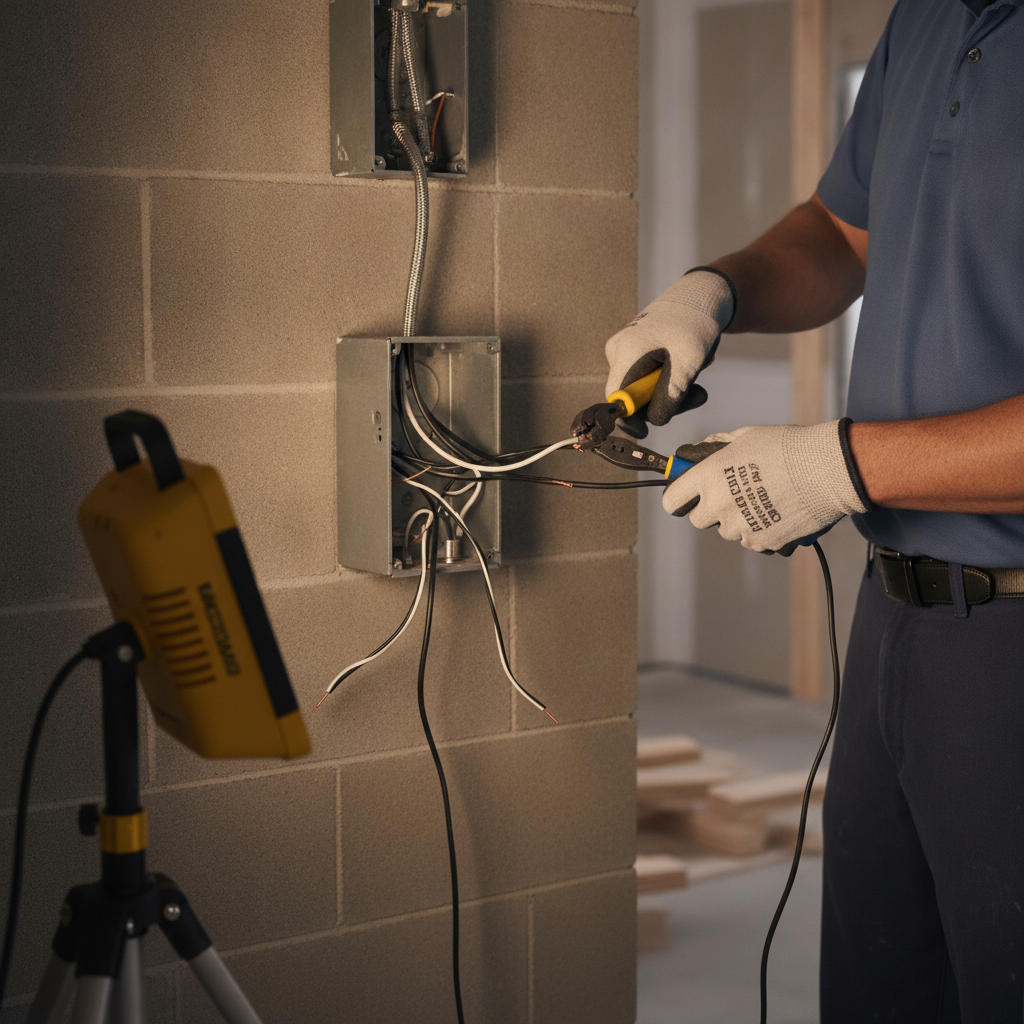
Aluminum wiring remediation starts at the connections: a licensed electrician inventories every aluminum branch-circuit termination in the house, then joins those conductors to copper pigtails with a listed connector or replaces the run. The U.S. Consumer Product Safety Commission frames that work as a complete connection inventory, which is the method this page covers for homes in Tampa and across Hillsborough, Pinellas, and Pasco. The history of those conductors in this metro lives in our note on aluminum wiring in 1970s Tampa.
How an electrician confirms aluminum branch wiring
The electrician confirms aluminum branch wiring on the conductor in front of them. Silver-colored solid wire on a lighting or receptacle circuit, with AL or ALUMINUM printed on the cable jacket in an attic, garage, or other unfinished space, is the usual field evidence. The wiring test is the metal and the marking on site.
Once that metal shows up, the job becomes a circuit-by-circuit inventory. A kitchen remodel may already have copper on the counters while the bedrooms still run aluminum. Mixed houses are ordinary around Tampa Bay. The electrician works through receptacles, switches, light fixtures, accessible splices, and the breaker terminations that feed those runs. Skipping a closet receptacle because the living room looked fine leaves that closet untreated.
They also read the device. Some receptacles and switches are listed for aluminum. Many are listed for copper only. A copper-only device landed on an aluminum conductor is a termination the inventory has to catch. Heat staining on a cover, a plug that sits loosely in the slots, and a crackle at the switch are reasons to treat that point as needing qualified work. Tampa Electric’s home safety page says a loose-fitting plug means the wall outlet needs repair, and that an electrician should check it. Unexplained flicker, a hot or discolored plate, buzzing, a burning odor, a shock, or frequent trips call for prompt qualified inspection. Smoke or fire means you leave the house and contact emergency services.
Aluminum grows a surface oxide that resists current. Under a screw, the metal also moves as it heats and cools, so a joint that started tight can work itself loose. A loose joint then runs hotter. That loop is why a new cover plate changes nothing, and why the listed repair lives at every termination.
Large aluminum service or feeder conductors are a different product than these small branch wires. The electrician separates service cable from the solid wires that land on devices.
Leave the panel cover on and leave the devices in the wall. Aluminum branch-circuit connections are licensed electrical work. Florida certified electrical contractors can work statewide; registered contractors work in their authorized local jurisdictions, and specialty licenses have bounded scope.
Listed pigtail connectors vs a full rewire
CPSC discusses two repair families: rewiring with copper, and approved connector methods, including COPALUM and AlumiConn, used under the conditions those products are listed for. Both start from the same inventory.
A listed pigtail keeps the aluminum run and changes the termination. The electrician joins the aluminum conductor to a short copper lead with a COPALUM crimp or an AlumiConn setscrew connector, then lands that copper on the switch or receptacle. The device then sees copper under its screws. Every connection on that circuit still has to be found. A living-room outlet done correctly still leaves the splice above the hallway light to be opened. Box fill matters, because adding a connector takes space in an old device box. Which listed product fits depends on the actual wire, the equipment, and the method the electrician is qualified to use. A later device swap has to preserve that listed splice.
A full rewire replaces the aluminum branch run with copper. That is the path when the insulation is damaged, when the run cannot serve the load now on it, or when walls are already open. Fishing a new cable through Hyde Park plaster is a slower access job than pulling through an unfinished garage. Access, plaster versus drywall, and how many circuits are involved are what move the labor.
| Method | What changes | What stays |
|---|---|---|
| Listed connector pigtail | Each inventoried connection, joined to copper with COPALUM or AlumiConn under that product’s listed conditions | The aluminum cable in the wall |
| Copper rewire | The branch-circuit conductors on the affected runs | Other equipment, evaluated on its own |
This site publishes connector remediation at $2,000 to $5,000 and a full rewire at $8,000 to $18,000. Those figures are this site’s published ranges. They are not a Tampa average and they are not a quote. Number of connections, wall repair, and whether a run has to come out all move the price. The selected contractor sets the actual number after inspecting the property.
The electrician confirms the permit and inspection steps with the authority for that address. City of Tampa, unincorporated Hillsborough, and Largo each have their own permit counter.
What remediation does not fix
Aluminum branch-circuit remediation treats the aluminum-to-device problem. Everything else in the house keeps its own scope.
Service size and circuit space are a different decision. Filling a packed panel with new copper home runs may still leave no room for an added circuit. That is a panel upgrade conversation, judged from the actual loads and the actual can. A packed panel in a concrete-block house, with the meter can on the exterior wall, still has the same service size after the branch connections are treated.
Two-prong receptacles are a grounding question. A listed pigtail can put copper on the device screws and still leave a circuit without an equipment ground. That is the subject of our ungrounded outlets page.
A scorched receptacle, a cracked switch, or melted insulation is failed equipment. The connector method assumes a sound conductor and a box that can take the listed hardware. Damaged cable is a replace-the-run job.
A sale and an insurance file stay with the buyer, the lender, and the carrier. What you can hand them is the inventory and the listed method that was used.
The electrician who remediates aluminum is sizing COPALUM, AlumiConn, or a copper pull from what is on site. Adding circuits, moving a panel, and landing a generator or a charger are separate designs. Those show up in the same visit only when they are in the actual scope. A South Tampa plaster wall that already has to be opened for a rewire is a chance to place boxes where you want them. A connector-only job in a finished Riverview living room leaves the paint and the plaster alone, and leaves the panel exactly as it was. Tampa Electrical Pro matches the homeowner with that electrician. The electrician confirms permit and inspection with the building department that covers the parcel.
Cost, selling, and a full rewire
How much does aluminum wiring remediation cost?
This site publishes $2,000 to $5,000 for connector remediation and $8,000 to $18,000 for a full rewire. The selected contractor prices the house after the inventory. A small condo with a handful of devices and a two-story South Tampa house with plaster walls will not land in the same place on that band. Hardware and drywall repair sit on top of the electrical labor. The number of connections is the main driver on the connector path. Wall access is the main driver on a rewire. Permit fees are set by the reviewing authority for that address.
Can you sell a house with aluminum wiring?
A Tampa sale runs on the contract, the inspection, and what the buyer and the lender request. Electricians document the conductors they found and the listed method they used. That packet is what you can put in front of the other parties. Carriers write their own rules, so the electrical deliverable is the inventory plus the listed method. Your real-estate agent and your insurance agent can tell you what documentation they want to see.
Is a full rewire always worth it?
A rewire earns its cost when the run itself is the problem: damaged insulation, a cable that cannot serve the load, or walls already open for other work. Listed connectors are the CPSC-discussed repair when the conductor is sound and every connection can be reached. The electrician on site picks from those two families after the inventory. A written list of every connection treated is part of what makes the connector path make sense later, when someone else opens a box.
When to call us
When a jacket in the attic reads ALUMINUM, when a device is hot, buzzing, or showing a burning odor, or when a buyer or inspector has asked for a listed method, that work belongs to a licensed electrician. Tampa Electrical Pro matches homeowners with independent licensed and insured electricians for aluminum wiring remediation. Call us at (813) 850-0320.