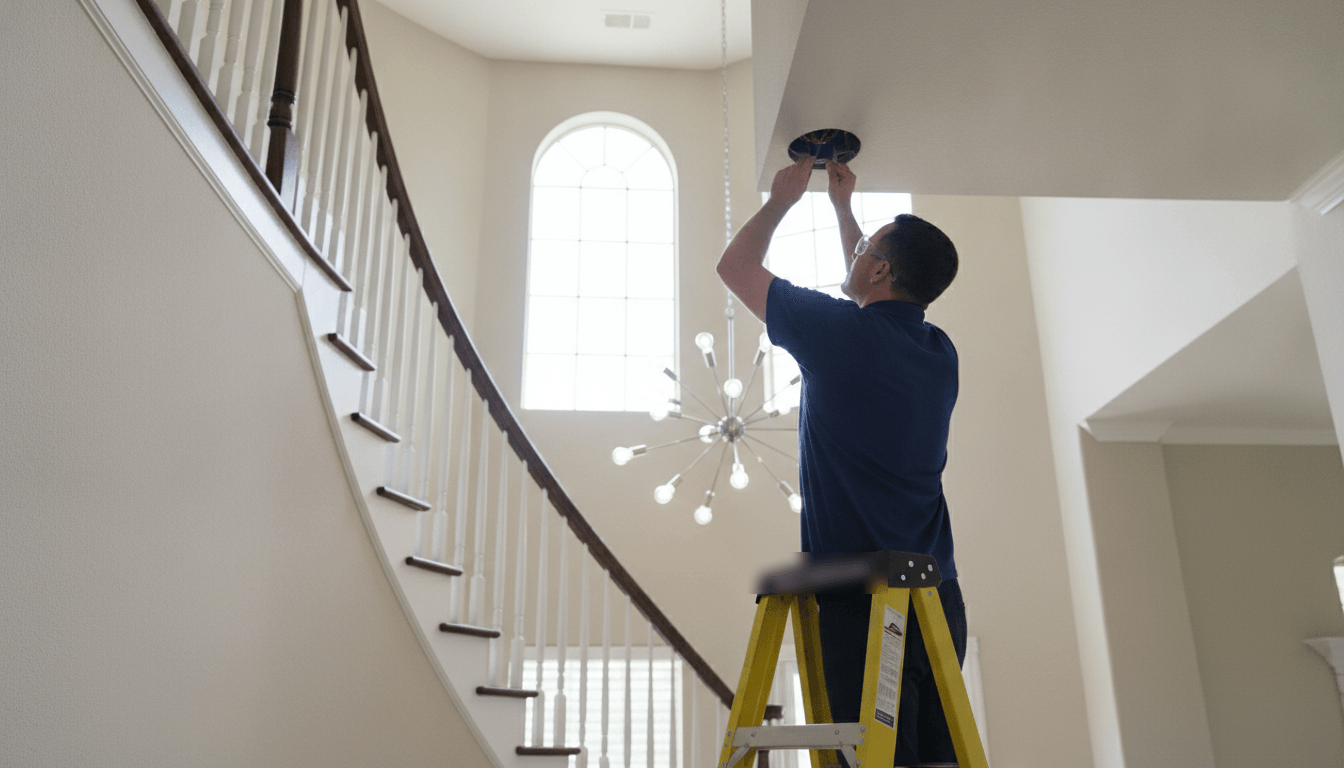
Chandelier installation cost in Tampa is decided by the box behind the fixture, not by the fixture. Tampa Electrical Pro doesn’t publish a flat rate, because somebody has to see the box, the fixture’s listed weight, the wiring and the access first. Swapping a fixture onto a box that’s already right for it is one job. Building new support over a two-story staircase is another.
What determines chandelier installation cost in Tampa?
The ceiling box, wiring, and access usually shape the quote. The chandelier’s purchase price doesn’t reveal any of those conditions.
An electrician needs to inspect several parts of the installation:
| Job condition | What needs verification | Why the quote changes |
|---|---|---|
| Existing ceiling box | Box type, marking, and physical support | The existing box may or may not suit the fixture |
| Fixture weight | The chandelier’s listed weight and mounting requirements | Heavier fixtures may need a different support method |
| Existing wiring | Cable condition, switch wiring, and grounding | Damaged or unsuitable wiring creates a separate repair |
| New fixture location | Box placement and the route for new wiring | Moving the fixture changes the electrical work |
| Foyer access | Ceiling height and staircase position | Safe access can require more setup and labor |
| New lighting circuit | Available panel capacity and the wiring route | A separate circuit expands the project’s scope |
That’s why two honest quotes on the same house can come back far apart. One electrician is pricing a fixture swap. The other one looked behind the canopy and found support or wiring work.
A new circuit doesn’t automatically mean a panel upgrade. It does mean somebody reads the panel before the scope gets written.
What is actually holding your chandelier up?
The visible canopy doesn’t tell you what supports the fixture. Behind it could be a standard luminaire box, a listed fan-rated box, or support that doesn’t rely on the box alone.
Those three aren’t interchangeable. Each one sends the job down a different path on labor and materials.
The National Electrical Code handles fixture weight by making the box carry a label. Here’s the rule in its own words, from the subsection covering luminaire outlets on a vertical surface:
“314.27(A)(1) Vertical Surface Outlets. Boxes used at luminaire or lampholder outlets in or on a vertical surface shall be identified and marked on the interior of the box to indicate the maximum weight of the luminaire that is permitted to be supported by the box if other than 23 kg (50 lb).”
So 50 pounds is the code’s default, and anything else has to be marked inside the box. That’s a number a homeowner can’t see from the floor. It’s also the whole reason an electrician wants the canopy down before quoting a heavy fixture.
A fan-rated box is a separate listed product. NEC 314.27(C) states:
“Outlet boxes or outlet box systems used as the sole support of a ceiling-suspended (paddle) fan shall be listed, shall be marked by their manufacturer as suitable for this purpose, and shall not support ceiling-suspended (paddle) fans that weigh more than 32 kg (70 lb). For outlet boxes or outlet box systems designed to support ceiling-suspended (paddle) fans that weigh more than 16 kg (35 lb), the required marking shall include the maximum weight to be supported.”
That cuts both ways. A light box isn’t automatically a fan box, and a fan-rated box still has to be read for its own marking before a heavy chandelier goes on it.
The ceiling fan installation page covers the fan side of that distinction, and the ceiling fan installation cost guide walks through why the existing box matters before anything gets mounted.
Does a chandelier need a permit in Hillsborough County?
Don’t assume a hardwired chandelier project is exempt. Hillsborough County’s electrical exemption contains one low-voltage item:
“The installation or repair of a low-voltage system in an existing single-family residence when the work is performed by the property owner or the work is performed by a non-owner, provided the total cost of labor and materials does not exceed $5,000”
A 120-volt lighting circuit isn’t low-voltage work, so that exemption doesn’t reach it. The county’s minor-repairs list is the one people misread. It exempts a long list of cosmetic work, and then it names what stays on the permit-required side:
“The alteration of, replacement or relocations of any standpipe, water supply, sewer, drainage, drain leader, gas, soil, waste, vent or similar piping, electric wiring systems or mechanical equipment, or other work affecting public health or general safety”
Read those two lists together and the line lands somewhere most homeowners don’t expect. Decorations and furnishings are exempt. Altering the wiring isn’t. Moving the box, adding a switch leg, running a new circuit or wiring in a dimmer all change the wiring system.
So don’t assume a small job is an exempt job. The electrician or the county confirms the permit path for the scope you actually have. Electrical permit fees typically run $75 to $150 depending on the municipality. Pinellas and Pasco permit separately, and homeowners there should confirm with their own county.
Florida inspectors also check the support behind the fixture. Miami-Dade County’s published electrical checklist includes this line:
“Check Outlets boxes for suitability of use. NEC 314.27”
Its checklist separately states:
“Check lighting fixture outlet boxes at luminaire or lamp holder outlets for suitability floor boxes. NEC 314.27 (A) and (B)”
That’s Miami-Dade’s checklist, not Hillsborough’s. It’s worth reading anyway, because it shows a Florida building department treating box suitability as its own inspection item rather than an afterthought.
Who’s allowed to do the work is a separate question, and what a handyman can legally do in Florida covers it in full.
How does a Tampa foyer change the installation?
A two-story foyer changes access before the electrical work begins. The electrician must reach the box, handle the fixture, and complete connections above an open staircase.
That layout is everywhere across New Tampa, Westchase, FishHawk and Wesley Chapel. Same chandelier, same wire, very different workday.
Photos help, but they don’t settle it. The electrician still needs the ceiling height, the landing position, the fixture’s weight, and a look at the canopy and the box.
Assembly matters too. Some chandeliers show up mostly built. Others come as a crate of arms and crystal that has to be put together before anything gets raised. An honest estimate accounts for that instead of guessing from a product photo.
If you’re in the city itself, the Tampa electrician page is the place to start.
What does Tampa Electrical Pro charge for chandelier installation?
Nothing, and that’s deliberate. Tampa Electrical Pro publishes no per-fixture chandelier price anywhere on this site, because a sight-unseen number hides every condition that actually controls the work.
The fastest route to a useful quote is providing:
- The chandelier’s product page or installation sheet
- The manufacturer’s listed fixture weight
- A photo of the current ceiling fixture
- A wider photo showing the room and access
- The approximate ceiling location and staircase layout
- Whether the fixture stays in the same position
- Whether a new switch or circuit is requested
Those details separate a fixture swap from a support, access or wiring project before anyone drives out. The electrician still confirms the box on site before the scope is final.
If the box or the wiring needs correcting, electrical repair becomes part of the project. Comparing other lighting work? The recessed lighting installation cost guide runs the same exercise for cans.
Get matched with a licensed electrician
Tampa Electrical Pro matches homeowners with licensed and insured electricians across Tampa Bay. The matched electrician inspects the box, wiring, fixture, and access before quoting the job.
Call (813) 850-0320 to discuss your chandelier installation. Share the fixture weight, ceiling photos, and installation location when possible.
Frequently asked questions
How much does chandelier installation cost in Tampa?
Tampa Electrical Pro doesn’t publish a flat chandelier rate. The ceiling box, fixture weight, wiring scope, and foyer access must be inspected before an electrician can give a responsible quote.
Can my existing light box support a chandelier?
Possibly, but the box and its support must be inspected. The old fixture’s weight doesn’t prove the concealed box suits a heavier chandelier.
Is a fan-rated box automatically right for a chandelier?
No box should be approved by its label alone. An electrician must compare its marking and support with the chandelier manufacturer’s mounting requirements.
Does Hillsborough County require an electrical permit?
Hardwired lighting work isn’t covered by Hillsborough County’s low-voltage exemption. The contractor or county should confirm the permit requirement for the project’s exact scope.
Why does a two-story foyer cost more to work in?
A tall foyer over a staircase changes access and setup. It can turn a straightforward fixture swap into a longer installation, even when the wiring stays unchanged.
Can a handyman install a chandelier in Florida?
Paid electrical work falls within Florida’s electrical licensing rules. Tampa Electrical Pro matches homeowners with licensed and insured electricians for chandelier installation.