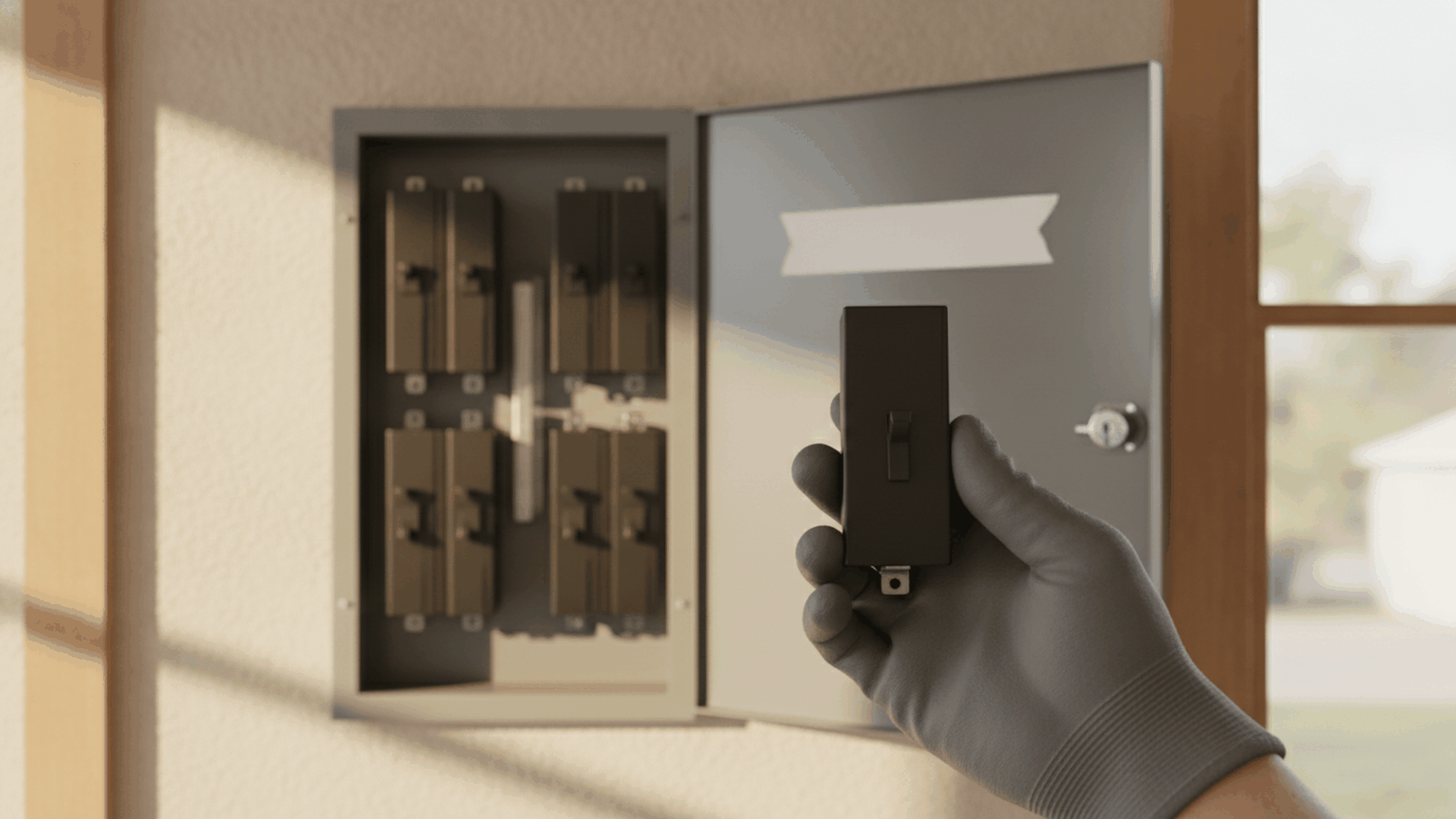
Circuit breaker replacement cost in Tampa usually falls within $150-$450 for an electrical repair visit that includes diagnosis and a straightforward swap. A service call alone runs $75-$150 and is usually credited toward the repair. If the panel is obsolete or damaged, the job may become a $2,500-$4,500 panel upgrade instead.
There’s no honest flat price for swapping one breaker, and nobody quoting you a menu number has seen your panel. What you’re paying for is the visit: someone opening the panel, finding out why the circuit failed, and telling you whether a new breaker actually fixes it. That’s why our published numbers describe visits and projects rather than parts.
What does circuit breaker replacement cost in Tampa include?
The $150-$450 electrical repair range we publish already includes the diagnostic visit. That’s the common path, where an electrician traces the fault and finishes the repair in the same trip.
Here’s how our published numbers fit together:
| Cost item | Published range | What the number covers |
|---|---|---|
| Service call or diagnostic | $75-$150 | The evaluation, usually credited toward the repair |
| Electrical repair visit | $150-$450 | Diagnosis and repair on the same visit |
| Electrical permit | $75-$150 | A planning range for Hillsborough and Pinellas, not a county quote |
| Standard panel upgrade | $2,500-$4,500 | A 100-to-200-amp upgrade, when the panel is the real problem |
These aren’t four charges stacked on one invoice. The service call is usually credited toward completed electrical repair, and permit cost tracks the jurisdiction and the scope of the work.
The $150-$450 figure isn’t a per-breaker menu price either. It’s what a repair visit costs. The honest quote comes after someone sees the panel.
Why does diagnosis matter before replacing a breaker?
Because a breaker is a warning device, and a new one won’t correct damaged wiring, overloads, loose connections, or ground faults. Every one of those conditions is still there after the swap.
That’s our published position, and it’s worth saying plainly: replacing a breaker just to stop repeated trips removes the warning and leaves the hazard. The first job is finding out why it opened.
Our breaker troubleshooting guide covers the causes behind repeated trips. This page picks up where that one ends, at what the repair costs.
Sometimes the diagnosis really does land on a failed breaker. Other times it’s a damaged connection, a circuit carrying more than it should, or a defect in the panel itself. Each of those is a different repair, and that’s the whole reason the range has a top end.
Why can’t an electrician choose a breaker by amperage alone?
Because amperage isn’t what establishes compatibility. The panel’s own listing and labeling decide which replacement breaker it accepts.
Miami-Dade County’s issued electrical inspection guidelines are a useful Florida example of how that gets checked. They direct inspectors to verify installations against the instructions in the equipment’s listing and labeling, naming NEC 90.7 and 110.3(B).
The same guidelines have inspectors check overcurrent devices for compatibility with the conductors they protect, under NEC 240.4, 110.14 and 310.15.
So the right part gets read off the label, not picked off a shelf by amp rating. That’s a small step that keeps the repair inspectable.
Opening the panel for a label check can turn up older work too. A double-tapped breaker is a different correction than a failed one, and it’s the kind of thing that shows up sitting next to the breaker you actually called about.
Does Hillsborough County require a breaker replacement permit?
Yes. Hillsborough County’s exempt-work list carries no exemption covering breaker replacement. Its only electrical exemption reads:
“Low-voltage systems: The installation or repair of a low-voltage system in an existing single-family residence when the work is performed by the property owner or the work is performed by a non-owner, provided the total cost of labor and materials does not exceed $5,000”
A branch-circuit breaker inside a panelboard isn’t a low-voltage system, so that entry doesn’t reach this work. There’s no second electrical exemption on the list to fall back on.
The county also rules out its residential exemption when:
“The work includes electrical, plumbing, structural, mechanical or gas work”
We publish electrical permit fees of $75-$150 for Hillsborough and Pinellas, and that’s a planning range rather than a county quote. Pasco homeowners should confirm the requirement with their own permitting office before assuming it matches.
Can I replace a circuit breaker myself?
Florida gives property owners a narrow owner-builder exemption, and it isn’t a general permit waiver. The owner has to apply for the permit, supervise, and do the work.
It only covers a single-family or duplex residence the owner uses and occupies, and the property can’t be intended for sale. Miss any one of those conditions and the exemption doesn’t apply.
Paying someone is a different question entirely. Under Florida’s licensing rules, compensation is what makes electrical work contracting, not how small the job looks. Our guide to handymen and electrical work in Florida walks that boundary in detail.
The practical catch is the same one as always. Swapping the breaker doesn’t correct an overload, a loose connection, a damaged conductor, or a ground fault, so a DIY swap can leave you exactly where you started with the trips.
When does breaker replacement become a panel upgrade?
When the panel is damaged, obsolete, or has no approved replacement breaker available for it. At that point you’re no longer buying a part, you’re deciding what to do about the equipment holding it.
Federal Pacific and Zinsco are both out of business, and compatible replacement breakers keep getting harder to source. If either name is on your panel, start with Federal Pacific panels and why Zinsco panels fail before pricing a single breaker.
A damaged bus does the same thing to the scope. In those cases an electrician is likely to recommend a panel upgrade rather than dropping a new breaker into the equipment that’s the actual problem.
Our published range for a standard 100-to-200-amp panel upgrade is $2,500-$4,500, and that’s a separate project from the $150-$450 repair visit, not an add-on to it.
Can breaker defects appear on a Citizens 4-Point form?
Yes. The current Citizens 4-Point Inspection Form lists “Improper breaker size” and “Double taps” right in its Hazards Present grid.
Citizens instructs agents not to submit applications for properties with existing hazards or deficiencies, and the form treats acceptable condition as equipment working as intended with no visible hazards or deficiencies.
None of that predicts a particular underwriting result, and we won’t pretend otherwise. It’s simply why the correct breaker and a clean terminal arrangement matter well before a 4-point electrical inspection happens.
When should a breaker problem get emergency attention?
A burning smell or a hot panel isn’t an estimate conversation. Call an emergency electrician and stay off the circuit until someone has looked at it.
Tampa Electrical Pro connects homeowners across Hillsborough, Pinellas, and Pasco with licensed electricians, and the network runs 24/7, including for anyone looking for electrical service in Palm Harbor.
Call (813) 850-0320 to arrange an inspection and quote.
Frequently asked questions
How much does it cost to replace a circuit breaker in Tampa?
Plan on our published $150-$450 electrical repair range, which includes the diagnosis. A service call on its own runs $75-$150 and is usually credited toward the repair.
We don’t publish a flat price for one breaker, because there isn’t an honest one. Someone has to look at the circuit and the panel first.
Is the replacement breaker included in the diagnostic fee?
Not necessarily. The $75-$150 covers the service call and the diagnosis, and it’s usually credited toward the repair once you go ahead.
Completed repairs land in our published $150-$450 range. Where you sit in that range depends on what the visit turns up.
Does the replacement breaker need the same amperage?
Matching the amperage isn’t enough on its own. The panel’s and the breaker’s listing and labeling are what establish an approved replacement.
A Florida county’s issued inspection guidelines have inspectors check exactly that, along with whether the overcurrent device suits the conductors it protects.
Why does my new breaker keep tripping?
Because a different breaker won’t fix damaged wiring, an overload, a loose connection, or a ground fault. If it’s still tripping, the circuit problem underneath it hasn’t been found yet.
Swapping the breaker to stop the trips removes the warning and leaves the fault in place.
Does Hillsborough County exempt breaker replacement from permits?
No. There’s no entry on Hillsborough’s exempt-work list that covers replacing a branch-circuit breaker.
Its only electrical exemption is for qualifying low-voltage systems, and the separate residential exemption is ruled out for any job that includes electrical work.
When might I need a full panel upgrade instead?
When the panel is damaged, obsolete, or has no approved replacement breaker available. Federal Pacific and Zinsco panels raise that question early, since both companies are out of business and their breakers keep getting harder to source.
Our published range for a standard 100-to-200-amp upgrade is $2,500-$4,500, separate from the repair visit.