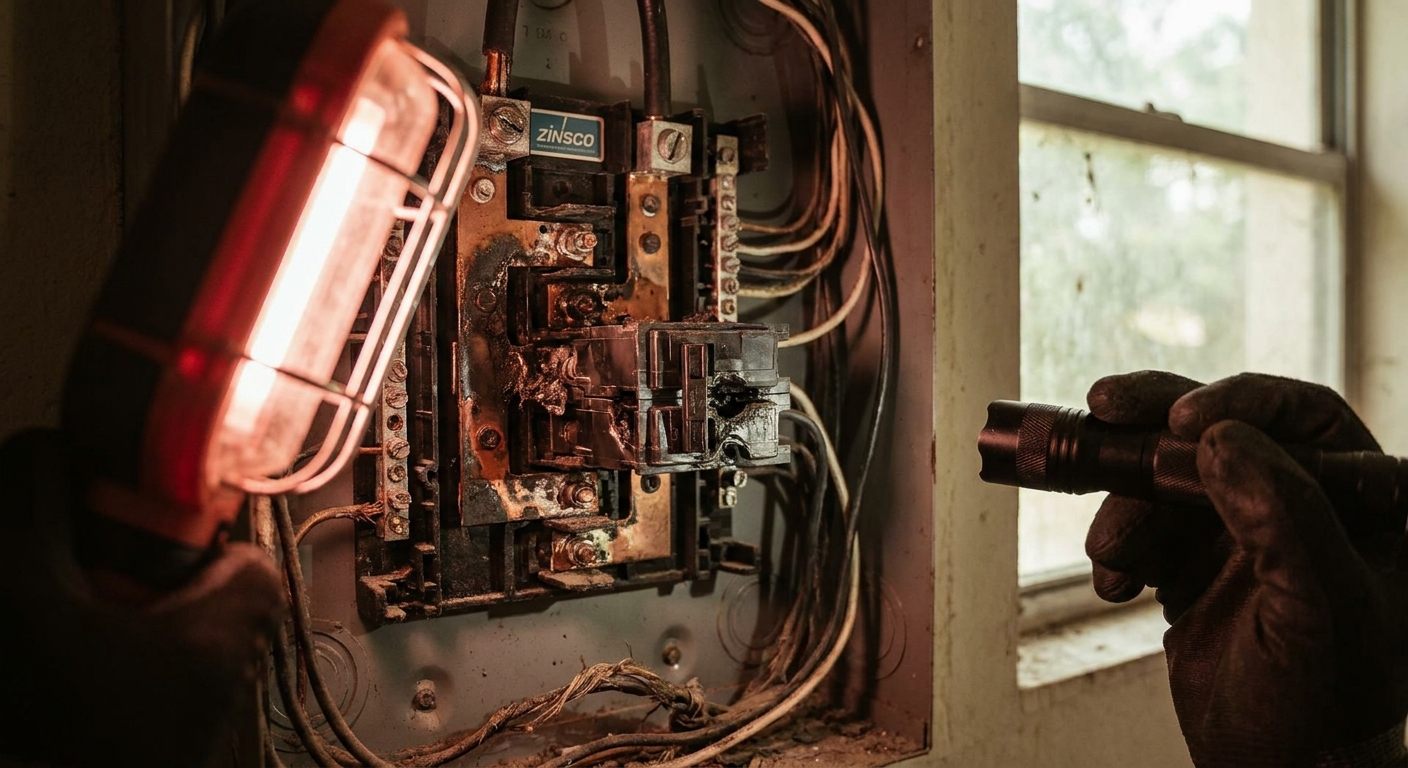
Zinsco panels get less attention than Federal Pacific panels, but they carry a similar reputation among electricians for good reason, and they’re still out there in a meaningful number of older Tampa Bay homes. If you’ve never heard the name before, it’s worth five minutes to find out if you own one.
What Zinsco was
Zinsco Electrical Products manufactured residential breaker panels from the 1950s through the 1970s, later selling under the Sylvania-Zinsco name after an acquisition. They were common and reasonably priced, which meant a lot of builders across the country used them during the same construction boom that put Federal Pacific panels in so many homes of the same era.
Like Federal Pacific, Zinsco is no longer in business, so there’s no ongoing manufacturer support, no recall process, and increasingly, difficulty even sourcing replacement breakers when one fails.
The documented problem
Zinsco panels have two well-documented failure modes. The first is breakers that fail to trip properly during an overload, the same core problem as Federal Pacific panels, which allows a circuit to keep drawing current past a safe threshold instead of shutting off.
The second, and more specific to Zinsco, is a design where the breaker connects to the panel’s bus bar with a design that can develop poor contact over time. As that contact degrades, it generates heat and arcing at the connection point, which can literally melt the bus bar and the breaker together. When that happens, the breaker becomes impossible to trip or reset because it’s physically fused to the panel, meaning your only actual protection against an overload is gone, and you likely won’t know it until something else goes wrong.
How to identify a Zinsco panel
Open your panel and look at the label and the breakers themselves. Zinsco panels often have a distinctive colored breaker design, commonly with red, blue, or multicolored toggle switches that stand out from the more uniform black breakers in a modern panel. The label inside the panel door, if still legible, will say “Zinsco” or “Sylvania-Zinsco.” Some Zinsco-manufactured panels were also sold under other brand names after the company was acquired, which can make identification trickier, so if you’re not fully sure, a licensed electrician can confirm it quickly.
Where we see these in Tampa Bay
Zinsco panels show up in roughly the same housing stock as Federal Pacific panels, homes built primarily from the late 1950s through the 1970s. That means older sections of Seminole Heights and Tampa Heights, parts of Hyde Park, St. Petersburg’s bungalow neighborhoods like Kenwood and Roser Park, and pockets of Temple Terrace and Gulfport all have homes running on original or early-replacement Zinsco equipment.
Why you shouldn’t wait for a visible problem
The unsettling part of both the Zinsco and Federal Pacific panel issues is that they can function normally for years and then fail exactly when you need them most, during an actual overload or short circuit. There’s often no warning period. A panel that’s been “fine” for forty years isn’t evidence it’s safe, it’s evidence it hasn’t been stress-tested yet.
If your panel is confirmed Zinsco, most electricians, including us, recommend replacement rather than a wait-and-see approach, for the same reason we recommend it for Federal Pacific panels. The failure mode isn’t gradual and visible like a leak. It’s binary and it happens under load.
The insurance reality
Florida insurers have gotten sharper about flagging both Zinsco and Federal Pacific panels during underwriting inspections, treating them similarly to how they treat polybutylene pipe and aging roofs. If you’re buying, selling, refinancing, or renewing a policy on a home with a confirmed Zinsco panel, expect it to come up, and expect it to be a condition rather than a suggestion.
The inspection doing the flagging is usually a 4-point, required by Citizens on any home more than 20 years old. Our walkthrough of the electrical section of a Florida 4-point inspection covers what the form records about your panel and what counts as a hazard.
What replacement costs
Replacing a Zinsco panel with a modern 150 or 200 amp panel runs in the same range as a Federal Pacific replacement, typically $2,500 to $4,500 for most Tampa Bay homes, depending on panel size, service entrance condition, and permit fees through Hillsborough or Pinellas County. The job is usually a single day with a few hours of power downtime, and county inspection is part of the process.
Because parts for Zinsco panels are increasingly hard to source when a breaker does fail, replacement is often the more practical choice even setting aside the underlying safety concern. A single failed Zinsco breaker can be more expensive and time-consuming to track down and replace than the labor on a full panel swap.
Get it checked before it decides the timing for you
If your Tampa Bay home was built in that mid-century window and you’ve never had someone confirm what’s actually in your panel, that’s worth doing on your schedule rather than finding out during a home sale inspection or, worse, after something’s already failed.
What to do if you find a melted breaker
If you ever open your panel and see a breaker that’s visibly discolored, melted, or fused to the bus bar, don’t try to reset it or force it. That breaker has likely lost its ability to protect that circuit entirely, and forcing it can make the problem worse or cause a shock hazard. Shut off the main breaker if you can safely reach it, and call an electrician the same day. This is one of the few electrical situations in an older Tampa Bay home that genuinely can’t wait for a scheduled appointment.
Zinsco versus Federal Pacific: does it matter which one you have
Homeowners sometimes ask whether one panel brand is worse than the other. In practice, both carry similar real-world risk and both warrant the same response: replacement rather than a wait-and-see approach. The specific failure mechanism differs slightly, breaker trip failure for Federal Pacific versus bus bar degradation for Zinsco, but the practical advice for a homeowner is identical either way. Don’t spend time trying to determine which is the “safer” option to live with. Neither is.
Call (813) 850-0320 and we’ll identify what you’ve got, give you a straight answer, and quote the replacement if it’s needed.