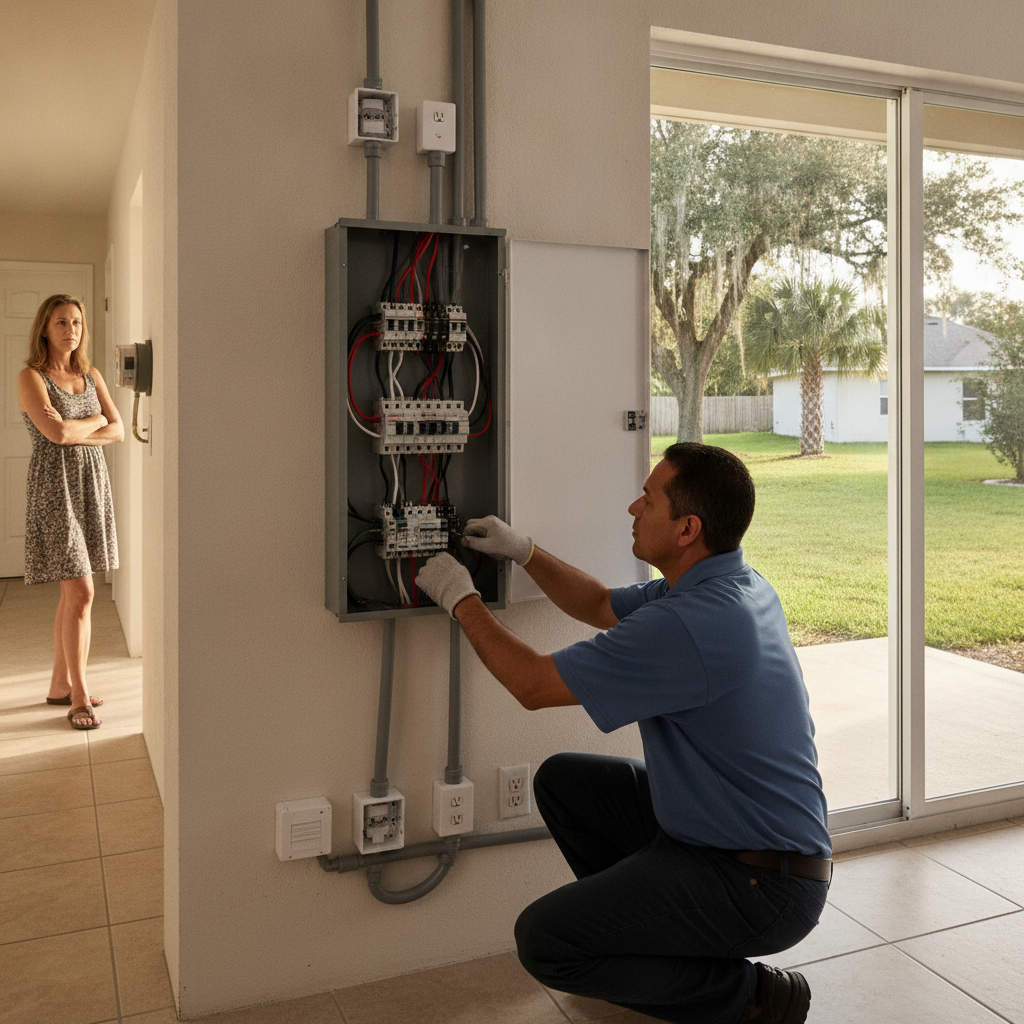
The freezer in a Brandon garage goes quiet while the kitchen stays on, and the breaker that should feed that bay is still in the ON position. That is a repair call, not a new install. A licensed electrician has to find the open, the failed device, or the upstream GFCI that already tripped, and Tampa Electrical Pro matches Brandon homeowners with independent licensed and insured electricians who do that tracing.
What electrical repair covers in a Brandon house
Electrical repair restores a circuit that already exists in the house. It is the dead receptacle, the switch that no longer throws the light, the breaker that will not stay on, the GFCI that will not latch, heat at a cover plate, or one room that went dark while the rest of the house is still live.
It is not a new 240-volt run, and it is not a panel upgrade unless the electrician finds that the panel itself is the failed equipment. Those are different jobs. Repair starts from a symptom and works backward through the circuit that is supposed to feed it. That work is electrical repair and troubleshooting.
On a slab-on-grade Brandon house, that circuit might leave an interior panel, pass a concrete-block wall, and land at a garage freezer, a lanai receptacle, or a bedroom split that shares a bathroom GFCI. The electrician identifies the actual path at the property. A street name in Brandon does not establish the wiring, the panel type, or the failed part.
A lot of what people file under electrician services in Brandon is this restore-and-stop work. New lighting, a generator, or a service change is a separate conversation. If you already know you need that broader visit, the Brandon electrician service page maps those other jobs.
What the electrician has to see is practical. Whether the circuit is existing or new. Route and access. The load that was on it when it failed. Indoor, damp, or wet exposure. Whether the symptom is constant or comes and goes. Whether the failed point is a device, a splice, a breaker, or equipment on Tampa Electric’s side of the meter.
After a storm, Tampa Electric is responsible for storm-related damage to the electric meter and the service line. Customers are responsible for damage to the weatherhead, the riser, and the meter box. That split exists so a homeowner knows which call to make. Fair-weather damage is a different question, and the electrician sorts it at the house. Customers are not allowed to make connections to or disconnections from Tampa Electric equipment.
Florida certified electrical contractors can work statewide. Registered contractors work inside the jurisdictions that authorize them. Specialty licenses have a bounded scope. The electricians we send are licensed and insured. They confirm permit and inspection steps with the building department that covers the property. A Brandon mailing address can still sit in unincorporated Hillsborough County. We do not pull permits.
Panel, breaker, and outlet failures
A dead receptacle, a hot device, and a breaker that will not reset are three different problems.
A dead receptacle with the breaker still on is the first. Power can stop at the device, at a splice in a box, or at protection the homeowner never sees. A GFCI in a bathroom, garage, or exterior box can protect plain receptacles further down the same circuit. Those downstream devices have no test and reset buttons. Missing buttons do not mean the circuit has no GFCI. The electrician hunts that upstream device before they replace the dead receptacle. A switched half-hot in a living room, a loose connection, or a failed receptacle all look the same from the couch: nothing works, and the breaker looks fine.
Tampa Electric’s home-safety guidance is direct on a related tell. If plugs fit loosely in a wall outlet, the outlet needs repair. Have an electrician check it. If one appliance repeatedly trips a breaker or has given a shock, unplug that appliance and have it repaired or replaced. Extension cords are temporary. They are not a substitute for a failed circuit. Unless you are a qualified electrician, do not try to repair electrical products yourself.
A hot device is the second pattern. A warm or discolored cover plate, a switch that smells when you use it, buzzing or crackling, or a shock from a device calls for a prompt inspection by a qualified electrician. Do not keep using the device. Do not open the panel to look. Unexplained flicker, heat, arcing, or odor is not something to wait out. If you see smoke or fire, leave the house and contact emergency services.
A breaker that will not reset is the third. Repeated trips are a fault, not a breaker with a personality. The electrician has to separate an overloaded circuit from a short, from a failing breaker, from an AFCI or GFCI that is doing its job. That tracing is the same work we walk through when a breaker keeps tripping. Standing at a Brandon electrical panel and flipping a breaker until it stays is how a small fault becomes a burned connection. Do not repeatedly reset a fault.
Sometimes the failed equipment is the panel itself. A bus that will not take a breaker, a main that will not latch, or physical damage to the can is not a receptacle job. Service capacity, circuit space, and a failed enclosure are three different problems. A dead outlet on a healthy circuit does not mean the house needs a new panel. Brandon electrical panels get replaced when the panel is the thing that failed, or when the repair the house actually needs will not fit the equipment that is there.
This site publishes $150 to $450 for electrical repair that includes the diagnostic visit. That is this site’s published range, not a Brandon market average and not a bid. The selected contractor sets the actual price after inspecting the property. What moves the number is access, how far the fault sits from the panel, whether the repair stays on the existing circuit, and whether the electrician is replacing a device or opening a longer run.
How a licensed electrician traces the circuit
The electrician traces a circuit from the symptom toward the source.
They confirm which breaker is supposed to feed the dead point, then they test at the receptacle, the switch, or the fixture. If that point is dead and the breaker is on, they look for an upstream GFCI or AFCI, a feed-through splice, or a lost hot or neutral in the last working box. Several dead receptacles along one wall often means the first device in the chain lost its feed-through. One dead receptacle with live neighbors often means that device failed.
A garage GFCI that also feeds the exterior receptacles will kill the patio outlets when it trips. The patio looks dead. The buttons sit in the garage. That is why the electrician does not start by replacing the first dead cover they see. They prove where the circuit is still live, then they work into the first dead box.
None of that is a homeowner job at the panel. The electrician de-energizes and verifies before opening equipment. You point at the symptom. They own the voltage.
What changes once they find the open is the condition of the run. Indoor versus a wet lanai or an exterior box. The conductor they actually find, and a connection method listed for it. If they find aluminum branch connections, the repair method has to be listed for that conductor. A street or a build year does not establish that the house has aluminum. A short path through a closet versus a finished hall. A failed breaker versus a failed cable. If the panel is out of spaces, or the service cannot carry the repair plus the load that caused the call, the job stops being a device repair and becomes an upgrade discussion.
For a house on Tampa Electric, the ownership line at a typical self-contained meter is the load-side terminals of the metering equipment. House-side work is the electrician. Connection or disconnection at company equipment is Tampa Electric’s. Mixing those up delays a repair that was never a utility ticket.
The electricians we send will say what they found in plain language: the device, the splice, the breaker, or the run, and what it takes to put that circuit back in service.
Questions about Brandon electrical repair
These questions cover a dead receptacle with a breaker that never moved, who pulls the permit, and whether the panel itself is the failed equipment.
Why is a receptacle dead if the breaker never tripped?
Power often stops at an upstream GFCI, a lost feed-through, or the receptacle itself. The breaker can sit ON the whole time. The electrician finds which of those three it is. A missing test-reset pair on the dead receptacle does not mean the circuit has no GFCI protection.
Who pulls the permit for electrical repair in Brandon?
The licensed contractor who does the work confirms permit and inspection steps with the authority that covers that address. Tampa Electrical Pro does not pull permits. A Brandon mailing address can still sit in unincorporated Hillsborough County, and a property inside a city limit is reviewed by that city. The electrician settles that from the property, not from the name on the mailbox.
When is a repair actually a panel replacement?
When the failed equipment is the panel: a main that will not reset, a bus that will not accept a breaker, or damage that a device swap cannot fix. A dead outlet on a healthy circuit is still a repair.
When to call us
A dead receptacle, a hot device, a burning odor, or a breaker that will not stay reset is licensed electrical work. The electricians we send diagnose the circuit, make the repair, and handle the permit steps the property requires. Call us at (813) 850-0320.