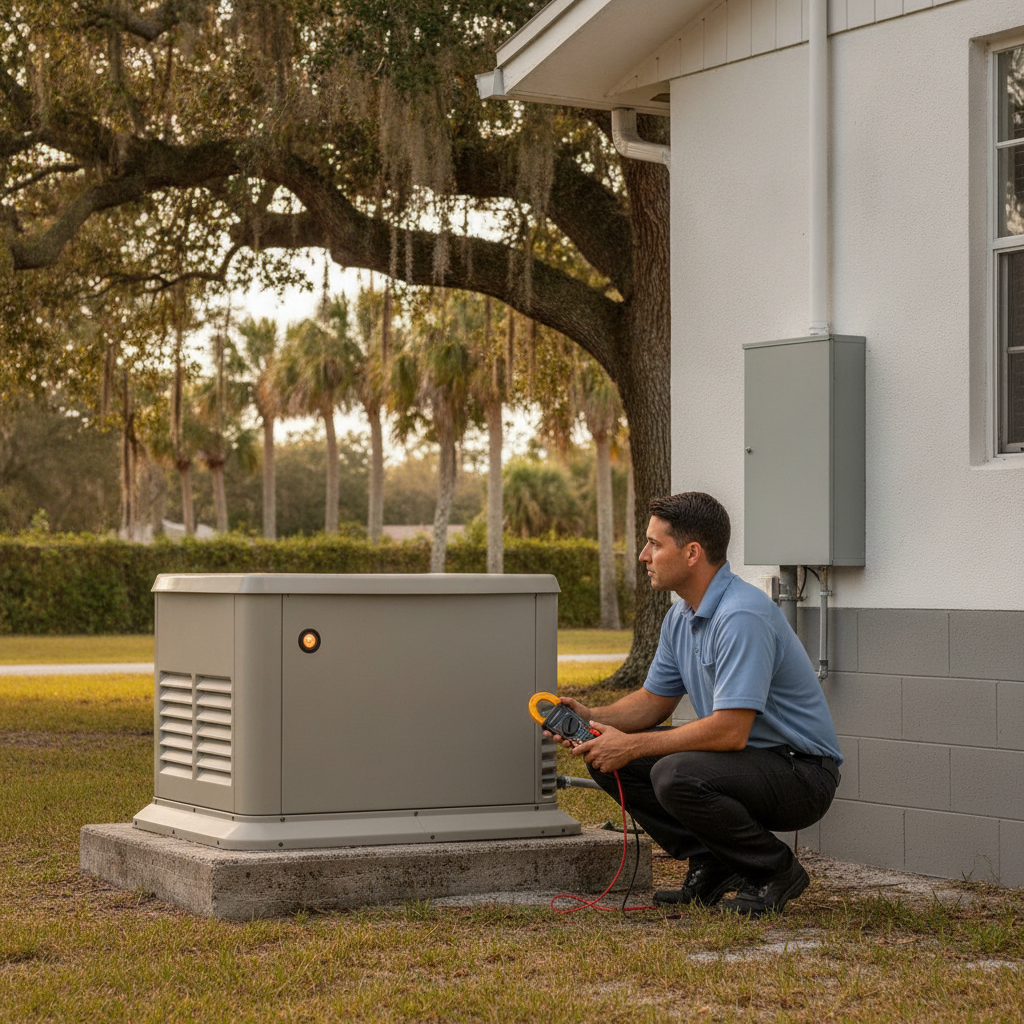
A standby generator that fails in Tampa usually fails at the worst possible moment: the exercise cycle throws an alarm in the middle of hurricane season, or the power drops and the unit never picks up the house. The first question is not “how fast can someone get here.” It is “which someone.” Generator repair is really three different trades, and calling the wrong one costs days.
The machine on the pad is an engine, a generator end, and a controller inside one enclosure. The wiring that connects it to the house is electrical work. The pipe that feeds it is fuel work. Each piece has its own repair path, and a Tampa homeowner who can tell them apart gets the right truck in the driveway on the first call.
The three repair paths, and who owns each one
Work inside the enclosure belongs to the service path for that brand and model. The engine, the controller board, and the scheduled engine service all follow the manufacturer’s documentation for the exact unit on the pad. Intervals and procedures are not interchangeable across brands or product lines, and the owner’s manual for that model is the governing text. Our post on standby generator maintenance walks through how those schedules work and why the model number comes first.
The wiring between the generator and the house belongs to a licensed electrician. That covers the transfer equipment, the feeder from the unit to the panel, the breaker that protects it, and any panel work the repair uncovers. Tampa Electric’s home safety guidance describes fixed standby equipment as professionally installed with transfer isolation from the utility, and that isolation hardware is squarely electrician territory. A whole-home generator referral through this site reaches electricians who handle exactly that side.
The fuel supply is its own trade. Natural gas and propane lines are installed and repaired by contractors qualified for fuel-gas work, not by whoever happens to be standing at the generator. A unit that shut down on low gas pressure is not an electrical failure, and an electrician who finds one will say so.
Florida’s licensing structure backs this split. Certified electrical contractors may work statewide, registered contractors work in their authorized local jurisdictions, and specialty licenses have bounded scope. Confirm the business is authorized for the address before work starts. The contractor for the property confirms any permit and inspection steps with the authority that actually covers the lot.
What you can check before calling anyone
Start outside the enclosure. Read the status display through the louvers and note any warning or service message, because that text is the first thing every repair call asks for. Look for leaves, stored items, or debris blocking the intake and discharge. Check whether sprinklers or roof runoff are soaking the unit. Note the hour reading if the display shows one, and find the service record.
Stop there. Do not open electrical compartments, remove covers, or pull the deadfront on the panel the generator feeds. Turning the main breaker off is not sufficient backfeed protection, and it does not make the enclosure safe to open. A fuel-burning generator also produces carbon monoxide whether or not it is behaving, so a unit that runs rough near a window is a reason to shut it down from the exterior controls and step away, not a reason to lean in closer.
Two situations skip the checklist entirely. If you see or smell fuel, or there is smoke or visible fire, leave the area and contact emergency services. And if the unit or the equipment that feeds the house is standing in water, stay away from it. Unexplained buzzing, a burning odor, or breakers that trip every time the generator exercises call for prompt qualified inspection, not another restart attempt.
When the generator runs but the house stays dark
A running engine with a dark house is almost always a transfer problem, and that is electrician work. Transfer equipment keeps generator power and utility power off the same conductors. On a standby system it opens the utility side and closes the generator side automatically, then reverses the sequence when the grid returns. When that handoff fails, the engine can roar all night without a single circuit picking up.
The repair starts at the transfer switch, the control wiring between it and the unit, and the breakers on both sides. Our transfer switch explainer covers what that equipment does in normal operation. Sometimes the fix is in the switch itself. Sometimes the fault is in the panel it feeds, and the electrician may find the repair scope includes an aging bus or a breaker that no longer holds, the territory of a panel upgrade rather than a generator part.
A portable tied in through an inlet has the same failure mode in manual form. If the interlock or transfer hardware at the panel is damaged or was never installed, the inlet is just a dead plug on the wall. The isolation hardware is the repair, because a cord into house wiring without it is a backfeed, which Tampa Electric’s safety guidance calls out as unsafe.
An exercise cycle that completes does not prove any of this away. A normal exercise run shows the engine can start and finish that programmed cycle. It does not prove the transfer equipment will isolate the utility correctly or carry the intended loads in a real outage.
Storm damage and flooded generators
After a storm, the repair path changes, because the utility gets a say. Tampa Electric’s Storm Center states that for a flooded home or business, power cannot be reconnected until the electrical system has been inspected by a licensed electrician, and that once repairs are made the electrician obtains verification from the local building inspection authority before power is restored.
Hillsborough County’s storm recovery guidance spells out the unincorporated-county version of that path: keep power off until a licensed electrician has inspected the system, and confirm the contractor holds a valid license and is insured to work in Hillsborough County. Where damage needs a permit, the electrician makes the repairs and calls for the required inspections before power comes back. Residents inside Tampa, Plant City and Temple Terrace are directed to their own city governments, and homes in Pinellas or Pasco follow their own county’s building department. A generator or panel that took water is part of that inspection, not a separate quick fix, and our post on flooded home electrical replacement covers why water-touched gear gets evaluated instead of simply restarted.
What a repair visit costs, and when replacement enters the conversation
This site publishes an electrical repair range, including the diagnostic visit, of $150 to $450, and emergency dispatch plus diagnostic at $200 to $450. Those are this site’s published ranges, not a Tampa market average and not a bid, and the selected contractor sets the actual price after seeing the equipment. The electrical side of a generator repair, the transfer switch, the feeder, the breakers, starts in that diagnostic territory. Engine and controller work inside the enclosure follows the brand’s service network and its own pricing, which this site does not publish.
Replacement is the other number on the table. This site publishes a whole-home generator, installed, at $10,000 to $18,000, again as a published range rather than a quote. A unit with repeated transfer faults, storm damage, and an engine out of its service life may be worth weighing against that figure, and what a whole-house generator costs breaks down what moves the number. The electrician who inspects the wiring side and the brand service provider who evaluates the engine give you the two halves of that decision. A backup plan still needs fuel, maintained equipment, and a defined essential-load list either way, because a generator is not a permanent cure for every outage.
Frequently asked questions
Who repairs standby generators, a dealer or an electrician?
Both, on different parts. Engine and controller work inside the enclosure follows the manufacturer’s service path for that model. The transfer equipment, feeder, breakers, and panel side belong to a licensed electrician. A gas supply problem belongs to a contractor qualified for fuel-gas work. The status display message usually points to which call comes first.
Why won’t my generator start?
The honest answer comes from the exact model’s manual and the message on its display, not from a generic list. What you can do safely is read the display, clear debris from the airflow from outside, and note the hour reading and service history. Do not open compartments or remove covers. If fuel smell, smoke, or standing water is involved, stay away and get the appropriate emergency or qualified help.
Can any electrician work on my generator’s wiring?
Florida certified electrical contractors may work statewide, registered contractors work within their authorized local jurisdictions, and specialty licenses are bounded. Confirm the business is authorized for your address and that its scope covers the work. The wiring side of a generator, transfer equipment, feeder, and panel, is standard licensed electrical territory regardless of the brand on the enclosure.
How much does generator repair cost in Tampa?
This site publishes $150 to $450 for electrical repair including the diagnostic visit, and $200 to $450 for emergency dispatch plus diagnostic. Those are published ranges for the electrical side, not quotes, and the contractor sets the real price after inspecting the equipment. Engine work inside the enclosure follows the brand’s service network and is priced separately.
When to call us
Call when the generator runs but the house stays dark, when a breaker tied to the unit keeps tripping, when the enclosure or the panel took storm water, or when you want the wiring side of a repair handled by someone licensed for it. The electricians we send are licensed and insured, and the contractor for your property confirms the permit and inspection steps with the city or county that covers the lot. Call us at (813) 850-0320.