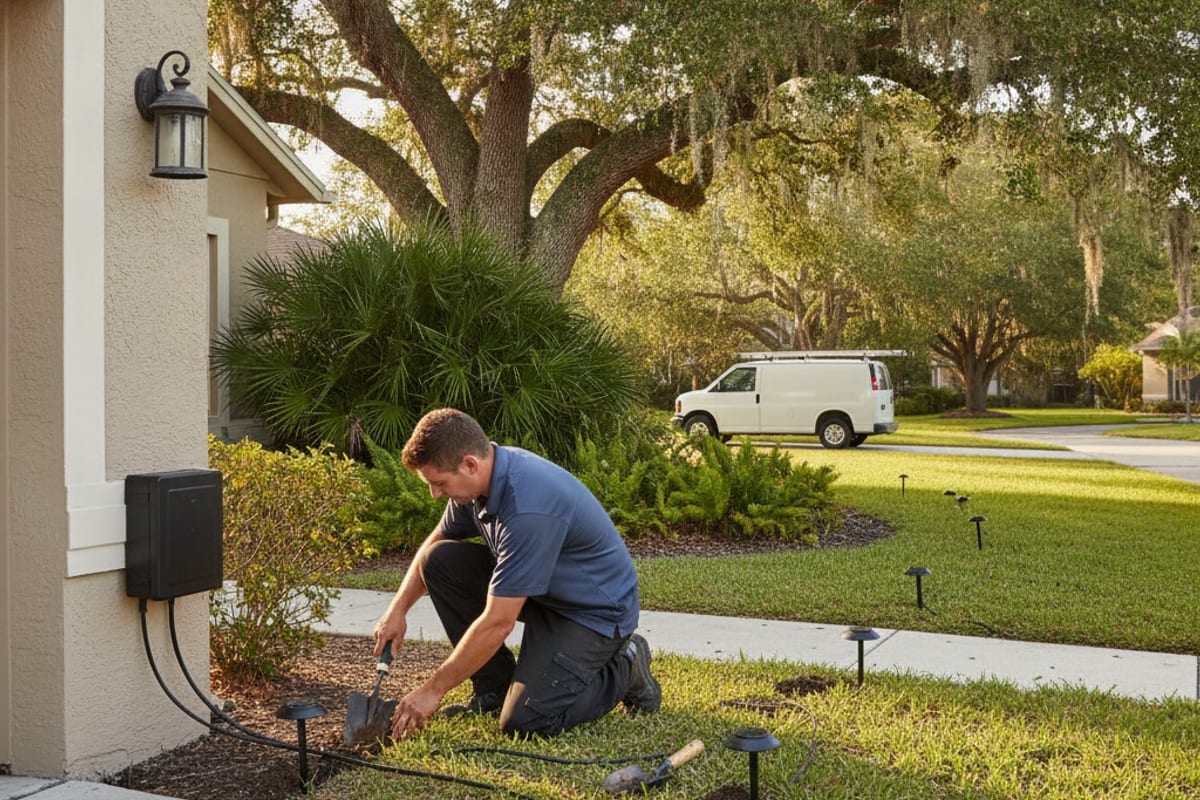
A working outdoor lighting setup in Seffner needs the right equipment, proper protection, and clean wiring that accounts for distance from the house. Hiring a contractor who understands both the low-voltage landscape side and the line-voltage receptacle feeding it makes the difference between lights that work all season and a system that dims, fails in wet weather, or trips the breaker.
Why landscape lighting in Seffner needs a real contractor
Many homeowners think landscape lighting is a weekend DIY job. It can be, if you’re replacing a fixture on an existing run that already has solid power and protection. Building a whole new system from scratch is different. The work spans two distinct electrical worlds. You’ve got household voltage feeding an outdoor receptacle and transformer on the house wall. Then you’ve got low-voltage cable running through landscaping delivering 12 volts to fixtures and controls.
A contractor with wiring experience sees both sides. They know whether the receptacle feeding your system needs GFCI protection, whether the existing circuit can handle the load, and what sized transformer matches your fixture count. They also know that a 100-foot run of thin cable will dim your far fixtures because voltage drops over distance. These details don’t show up in a lighting kit’s marketing photos.
Seffner sits in Hillsborough County with plenty of heat and humidity. Outdoor electrical work here also means the system has to tolerate afternoon sun, afternoon showers, and the occasional summer deluge. Equipment that looks outdoor-rated in a showroom can fail fast under real Gulf Coast exposure if the installation doesn’t match the conditions. A contractor familiar with the area knows which fixtures hold up and which don’t.
What an outdoor lighting contractor checks first
A visit starts with your power source. Do you have an existing outdoor receptacle, or does the electrician need to add one? A receptacle near where you want the transformer isn’t the same as the right receptacle. It needs to be on a circuit with capacity, and it needs GFCI protection. Older Seffner homes sometimes have outdoor receptacles that were installed decades ago without any ground-fault protection. Upgrading or adding GFCI protection on that branch is part of the job, not an extra cost you find later.
Load comes next. The contractor counts your fixtures, checks their wattage, and sizes the transformer. A 300-watt transformer isn’t one size fits all. Undersize it and your lights at the end of the run get dim. Oversize it and you’re paying for capacity you don’t need. The right one depends on how many fixtures, how far they’re spread, and what kind of wiring you’re using.
Cable run and routing matter more than most homeowners realize. A 40-foot run from the house to a far corner of your Seffner yard is manageable. A 150-foot run around the perimeter is a different animal. At that distance, voltage drop eats into the voltage reaching the fixtures, and dimming happens. A contractor can solve this with a larger cable size, a second transformer, a subpanel closer to the lights, or a combination. That’s a design conversation, not something you figure out after the system is installed.
GFCI protection for outdoor lights in Florida
GFCI protection isn’t optional for outdoor receptacles in Florida. It’s required by code. The device has to be a GFCI receptacle, or the receptacle has to be fed by GFCI protection from a GFCI breaker or another device upstream in the circuit. A receptacle that looks old and outdoor doesn’t tell you whether it’s protected. An electrician traces the circuit to find out.
A transformer plugged into a GFCI-protected receptacle doesn’t mean the low-voltage fixtures are protected the same way. They’re not. The transformer steps down to 12 volts. GFCI protection works on the high-voltage side. The low-voltage landscape circuit is different. It’s low-voltage, so shock hazard is lower, but it still needs its own protection. Many landscape transformers have a built-in breaker or fuse on the secondary side. The contractor verifies that’s in place and uses the right size.
Wet-location equipment goes beyond the GFCI. Receptacles, boxes, covers, and anything outdoors has to be rated for the actual exposure. A covered patio in Seffner is still a wet location if rain can blow in, or if AC condensation or irrigation water can reach the outlet. The cover on a cord plugged into the receptacle has to be weatherproof. A transformer mounted on an exterior wall has to be in an enclosure rated for wet location. The contractor picks equipment that matches the site, not guesses from the sun symbol on a label.
Choosing landscape fixtures that last
Low-voltage landscape fixtures come in dozens of styles. Underwater pond lights, LED path lights, spotlights, deck rail lights, and accent fixtures for plants all use the same basic 12-volt wiring, but they don’t all hold up the same way outdoors. In Seffner, fixtures that sit in mulch or get watered by irrigation need sealed connectors and corrosion-resistant materials. Brass, stainless steel, and powder-coated aluminum last better than untreated steel or cheap plastic housings that crack in the sun.
A contractor steers you toward fixtures that survive. They’ve seen which ones fail in a Seffner summer and which ones work year after year. They also know that a $10 path light and an $80 path light might look the same but won’t last the same. Budget matters, but so does having a lighting system that’s still working in two years.
Wiring and connectors are just as important. Underwater connectors, in-line splitters, and the cable itself all have to handle Florida weather. A corroded connection can arc or fail halfway through the season. Waterproof connectors and proper cable runs in mulch or under pavers make the difference.
When to call for help vs. maintaining what you have
If you already have landscape lighting and one section stops working, sometimes the fix is simple: check the timer settings, reset the transformer breaker, or tighten a loose connector. If the same section keeps failing, water is likely the culprit. A contractor can dig out the problem, replace corroded connections, reroute the cable, or add protection where moisture keeps sneaking in.
If you’re adding lights to an existing system, know whether the transformer and circuit have room for more load. Dimming that appears when you add one new fixture is a sign the system is at capacity. A contractor runs the numbers and tells you whether a larger transformer, a second one, or additional wiring is needed.
For a brand-new installation in Seffner, building it right from the start saves headaches. The contractor sizes the power, routes cable carefully, uses the right materials, and leaves you with a system that works through the summer heat, the afternoon downpours, and the occasional hurricane rain.
How to find a qualified landscape lighting contractor in Seffner
Not every electrician does outdoor lighting, and not every landscape company understands electrical safety. Look for someone licensed in Florida. A licensed electrical contractor (LEC) or registered electrical contractor (REC) has to follow code. Verify their license at myfloridalicense.com. A contractor licensed in Hillsborough County is familiar with local inspections and requirements.
Ask for references from outdoor lighting work. Has the contractor done landscape systems before, or is this their first time? Outdoor lighting is different from interior wiring. The contractor should be able to walk you through the transformer sizing, the cable run, the GFCI protection, and the fixture selection.
Get clarity on warranty and service. If a connection fails in the middle of summer, can you reach the contractor? Will they come back and fix it? A lighting system isn’t a set-and-forget install if you want it to keep working through Seffner’s weather.
FAQ
How much does outdoor lighting installation cost in Seffner?
Cost depends on fixture count, how far the run is from the house, whether you need a new receptacle or can use an existing one, and the quality of fixtures you choose. A simple 40-foot run with eight path lights might run $400 to $800. A 100-foot accent lighting system with multiple zones and a new receptacle can be $1,500 to $3,000. Get a site visit quote instead of guessing.
How far can you run low-voltage landscape lighting cable?
Voltage drop limits practical distance. A 100-foot run with thin 10-gauge cable will dim your far fixtures noticeably. A 40-foot run works fine. For very long runs, 8-gauge cable or a second transformer positioned midway solves the problem. Your contractor sizes the cable for the run.
Do landscape lights need GFCI protection in Florida?
Yes. The receptacle feeding the transformer has to be GFCI-protected. The transformer secondary (low-voltage side) is typically fused or breaker-protected inside the transformer itself. Both sides have their own purpose: the GFCI protects you from shock at the household-voltage receptacle; the transformer’s fuse protects the low-voltage wiring.
Can I add landscape lighting to an existing outdoor outlet?
Sometimes. If the outlet is on a circuit with room, and GFCI protection is in place, adding a transformer is straightforward. If the circuit is already full, or the receptacle lacks GFCI protection, the contractor will suggest adding a new circuit or upgrading the existing one. A visit determines which makes sense.
What happens to landscape lights in a summer storm?
GFCI-protected circuits trip during heavy lightning or power surges. That’s protection working. After the storm passes, reset the breaker or GFCI device and the lights come back. If they keep tripping, water has likely reached a connection or fixture. The contractor finds and repairs the wet point. Whole-home surge protection on your electrical panel can also reduce nuisance trips from nearby lightning.