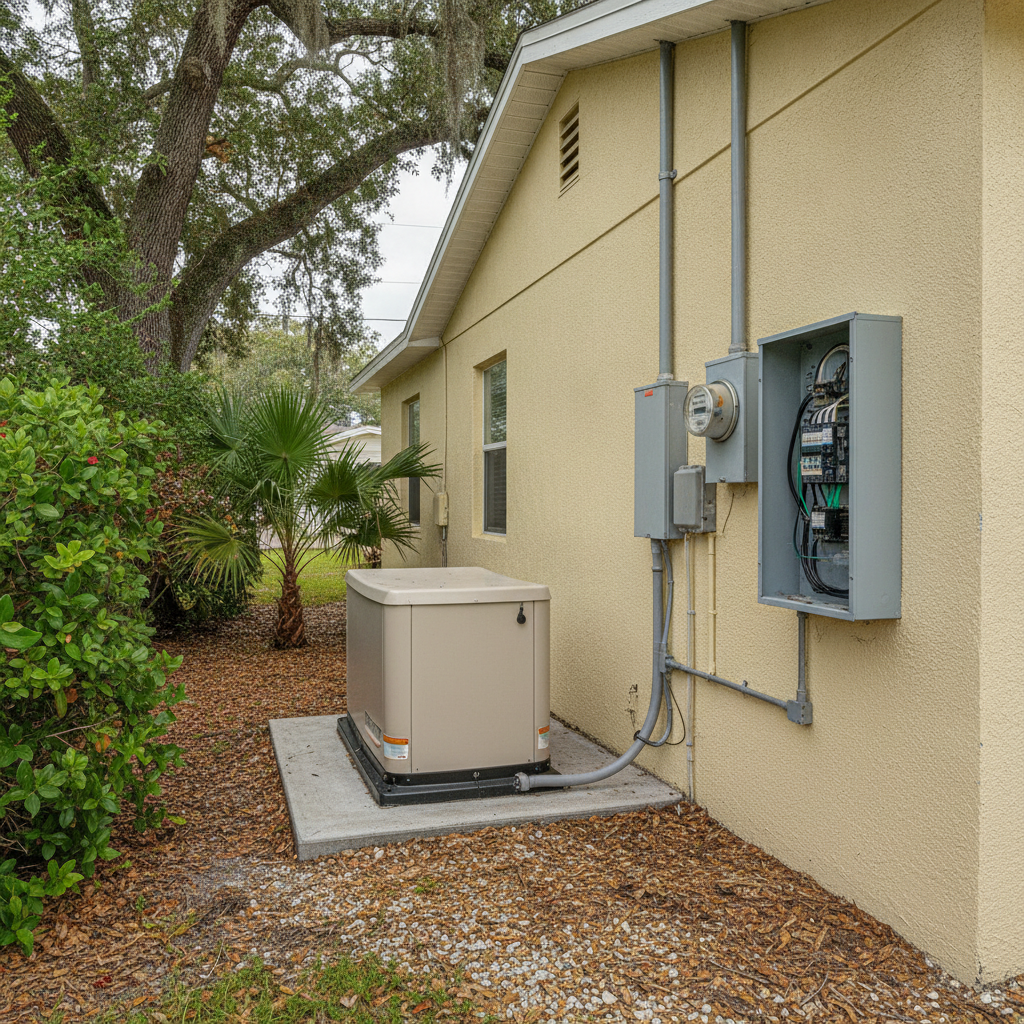
October is still hurricane season on the Pinellas peninsula. For backup generators, homes in St. Petersburg fall into two camps: the household writing an essential-load list for the first time this month, and the one that already lost power once and wants the next outage to be a non-event. Either way the load list is the same homework: fridge, a window of air conditioning, medical gear, a well or booster pump if the lot has one, a few lights.
A backup generator for that house is either a standby unit on a pad with transfer equipment that isolates the utility, or a portable tied in through a listed inlet. Those are different machines, and a St. Petersburg lot treats them differently.
Standby backup vs a portable on an inlet
A standby generator supplies backup power. It does not add utility load by itself. While Duke Energy Florida or Tampa Electric is up, the unit waits. When the utility feed drops, transfer equipment moves the house onto the generator. When the utility returns, it moves the house back. The grid and the generator do not share the wires.
That is the core of a whole-home generator install. The electricians we send build it from the load list, not from a badge on the crate. An essential-load design keeps the circuits you named. A whole-house design tries to carry the house as it already runs. Those are different scopes, different transfer setups, and different fuel draws. The generator never makes the service larger.
A portable takes another path. Tampa Electric’s home safety page states the mechanism: portables can power individual appliances through properly rated outdoor cords. Direct backfeeding into house wiring is unsafe. A cord into a dryer receptacle is backfeeding. Flipping the main breaker off does not isolate the utility.
The clean portable-to-house path is a listed generator inlet box on the exterior, landed on transfer equipment or a listed interlock at the panel. You still roll the unit out, start it, and plug into the inlet. The inlet is the connection. The isolation lives at the panel. The Florida-wide comparison of the two machines is in whole house versus portable generators.
An inverter portable can run selected household loads on those cords, and some electronics prefer that output. You still start it. It still produces carbon monoxide. The CPSC puts portable generators outdoors, far from the house and away from openings, and never inside a garage, home, crawlspace, basement, or shed.
Standby equipment is also a fuel-burning engine. Transfer isolation does not cancel exhaust. Fixed standby clearances come from that unit’s listed instructions and from local review.
| Decision | Standby on a pad | Portable on an inlet |
|---|---|---|
| How it starts | Transfer equipment runs the sequence when utility power drops, if fuel and upkeep are in place | You start it, then connect at the inlet or cord an appliance |
| What it feeds | The circuits the electrician maps, up to a whole-house design | Appliances on rated cords, or selected circuits through listed inlet and transfer gear |
| Utility isolation | Built into the transfer equipment | Required for any connection to house wiring |
| Exhaust | Outdoor, per the listed instructions and local review | Outdoor, far from openings. Never inside |
Transfer equipment that isolates the utility
Transfer equipment keeps generator power and utility power off the same conductors. If they occupy the same wires, the generator can energize the service drop. That is how utility crews get hurt, and how a generator dies when the grid slams back.
On a standby job, that isolation is automatic. Listed transfer equipment opens the utility side, then closes the generator side. When the utility returns, the sequence runs in reverse. You are not standing in the garage with a flashlight, guessing which breaker to throw.
A portable on an inlet needs the same isolation in manual form. A transfer switch, or a listed interlock that stops the main and the generator breaker from being on together, is the isolation. The inlet on the stucco is only the outdoor plug. Without the panel hardware, a neat inlet is still a backfeed.
Service capacity and circuit space are separate problems. A generator does not raise the amp rating of the service. If the panel has no room for the transfer gear, or the existing equipment cannot accept it, the electrician may include an electrical panel upgrade in the backup-power scope. That call comes from the labeling, the bus, the breaker spaces, and the route from the pad. The year on the property-appraiser site does not make it.
Fuel is a second path running next to the electrical one. Natural gas, propane, and diesel all burn. They all produce carbon monoxide, and standby equipment does not eliminate combustion exhaust. A unit on a gas meter still needs that supply through a multi-day outage. Keep fuel, keep the equipment maintained, and keep the essential-load list honest. A generator is not a permanent cure for every outage.
The electricians we send land this wiring. Florida certified electrical contractors may work statewide. Registered contractors work in their authorized local jurisdictions. Specialty licenses have bounded scope. Confirm the business is authorized for the St. Petersburg address. The licensed contractor confirms the permit and inspection steps with the authority that has the property.
What a St. Petersburg install has to clear
The reviewing office follows the lot, not the return address on the water bill. St. Petersburg is a Pinellas city with its own building department. Pinellas County’s list of building departments exists so a city property is not filed as unincorporated county work. Unincorporated Pinellas and a short list of partner cities go through the county. A Snell Isle, Kenwood, or Lakewood Estates mailing label does not settle jurisdiction. The electrician confirms the office for that address.
Placement is property-specific. A tight side yard on a bungalow, a pad that has to live behind the house because the HOA packet bans equipment in the front setback, a detached garage at the end of a long run: those facts move conduit, conductor, and fuel line. They do not tell anyone what is inside the panel. Standby clearances come from the listed instructions and local review. A portable’s far-from-openings rule is a different document.
The electrical run is usually where the labor grows. A generator on the far side of a Pinellas Point house, with the exterior panel on the street side, is a long 240-volt pull across a slab. A unit next to the meter can on a concrete-block wall is a short landing. Old Northeast plaster changes how a new circuit gets routed through the house. Context, not a diagnosis. The electrician sees the wall, the panel, and the fuel path.
This site publishes a whole-home generator, installed, at $10,000 to $18,000. That is this site’s published range, not a St. Petersburg average and not a bid. The selected contractor sets the actual price after inspecting the property. What moves the number: transfer equipment, run length, panel space or replacement, fuel routing, and access to the pad. The reviewing authority sets the permit fee.
Write the essential-load list before anyone orders a unit. Air handler, pool pump, irrigation, range, dryer, and an EV charger if the garage has one, each change the design. October is late in the season and still in it. Licensed and insured electricians in the St. Petersburg service area do the work. This brand matches homeowners with them.
After a storm, leave damaged and wet electrical gear alone. Where Tampa Electric is the utility, that company publishes a storm-related split: it handles the meter and service line, and the customer is responsible for the weatherhead, riser, and meter box. St. Petersburg homes served by Duke Energy Florida follow that utility’s own process. Smoke or fire means leave the area and contact emergency services.
Can you run a house on an inverter generator?
An inverter portable can run selected appliances through properly rated outdoor cords, and it can feed selected circuits when a listed inlet and transfer equipment are in place. It still needs you to start it, fuel it, and keep it outdoors away from openings. A quieter inverter does not turn a portable into a standby system, and a dryer-outlet cord is still a backfeed.
How much is a home backup generator?
This site publishes $10,000 to $18,000 for a whole-home generator, installed. That is a site-published range, not independent price evidence and not a St. Petersburg bid. The contractor who sees the panel, the run, and the fuel path sets the actual price. Gas-line work, pad work, and permit fees sit with that inspection and with the reviewing authority.
What is the best backup generator for a St. Petersburg home?
The right machine is the one whose transfer equipment isolates the utility, whose fuel you can keep through a multi-day outage, and whose load list matches the circuits you actually need. Standby if you want automatic coverage. Portable plus inlet if you will start it yourself and live on a short essential list. The electrician settles that at the house.
What are the downsides of a diesel generator?
A diesel unit is still a fuel-burning engine. Exhaust, fire, and carbon monoxide stay in the picture, and standby equipment does not cancel combustion exhaust. You also have to store and maintain that fuel through a Pinellas outage. Natural gas and propane carry the same combustion hazards on different fuel paths. The electrician matches fuel to what the listed equipment and the property can support.
When to call us
Call when you want a standby pad and transfer equipment designed for a St. Petersburg address, or when you want a portable tied in through a listed inlet instead of a dryer cord. The electricians we send are licensed and insured, and the contractor for that property confirms the permit and inspection steps with the city or county that actually has the lot. Call us at (813) 850-0320.