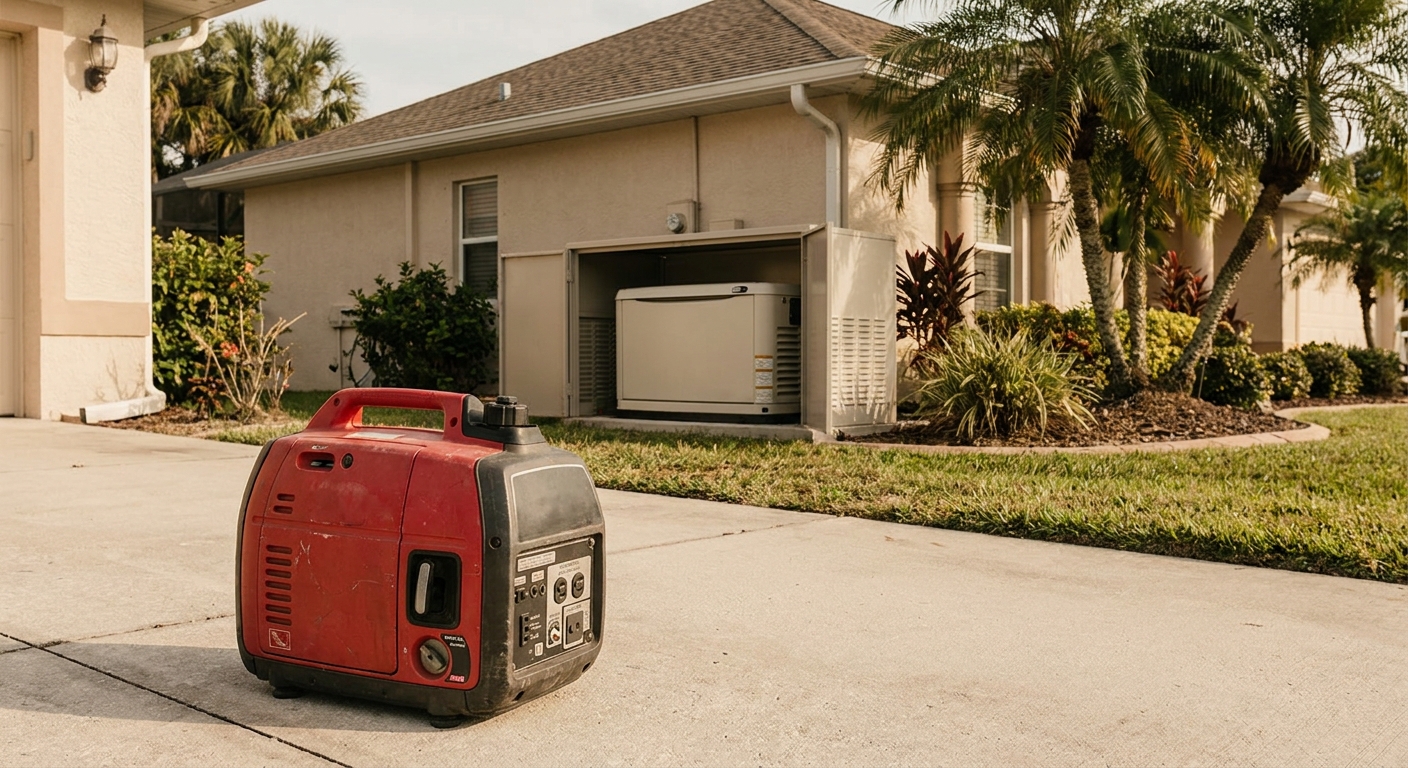
Every hurricane season, Tampa Bay homeowners face the same decision: buy a portable generator for a few hundred dollars, or spend real money on a whole-house standby system. We install both, so here’s the honest version of that comparison, not the sales pitch for whichever one makes us more money.
Portable generators: what they actually deliver
A portable generator costs $500 to $2,000 depending on wattage, runs on gasoline or propane you buy and store yourself, and needs to be manually set up every time the power goes out. That means dragging it outside, well away from windows, doors, and vents because of carbon monoxide risk, running extension cords into the house, and starting it by hand.
A mid-size portable unit can run a refrigerator, some lights, a few outlets, maybe a window AC unit if you’re careful about total load. It cannot run central air conditioning, and it will not power your whole house at once. You’re choosing which things matter most and running extension cords to reach them.
The fuel logistics are the part people underestimate. A portable generator burns through fuel fast, often a tank every 8 to 12 hours under real load, which means during an extended outage you’re either storing a dangerous amount of gasoline at home or making fuel runs to stations that may themselves be out of power or sold out, which happens constantly during an actual hurricane in Florida.
Whole-house standby generators: what they actually deliver
A whole-house standby generator installs permanently outside your home, connected directly to your electrical panel through an automatic transfer switch. When utility power drops, it detects the outage and starts itself, typically within 10 to 30 seconds, with zero manual setup. It can power your entire home, including central AC, which matters enormously in Florida heat during a multi-day summer outage.
Most run on natural gas, pulling fuel directly from the utility line with no storage or refueling needed, or on propane from an on-site tank sized for extended runtime. Either way, there’s no dragging equipment outside during an active storm, no extension cords, and no fuel runs.
The tradeoff is cost. A fully installed whole-house system runs $8,000 to $15,000 in Tampa Bay, depending on size and fuel type, against $500 to $2,000 for a portable unit.
The real question: how long are you actually without power
This is where the decision usually clarifies itself. If your neighborhood typically sees outages measured in hours, a portable generator covering the essentials might genuinely be enough. If you’re in an area that regularly goes days without power after a significant storm, which describes a lot of Tampa Bay’s coastal and barrier island communities including Davis Islands, Apollo Beach, and the Pinellas beach towns, a portable generator stops being a workable solution fast. Nobody wants to run extension cords and refuel a generator by hand for four days straight in July heat.
Inland communities generally see faster restoration, but “generally” isn’t a guarantee, and Tampa Bay’s lightning frequency means outages happen well outside hurricane season too.
Health and safety considerations
For households with older residents, anyone on medical equipment that requires power, or health conditions worsened by extreme heat, a portable generator’s limitations become a real risk factor, not just an inconvenience. Central AC during a multi-day summer outage isn’t a luxury in that situation, and a whole-house system’s automatic start means it’s running even if nobody’s physically home to set up a portable unit.
Noise and neighbors
Portable generators are loud, and running one for days in a residential neighborhood, especially in denser areas like South Tampa or Clearwater Beach condos, creates real friction with neighbors who are also dealing with a storm’s aftermath. Whole-house standby units are meaningfully quieter and designed for continuous residential operation.
HOA and resale considerations
In master-planned communities like FishHawk, Waterset, or Bexley, portable generators require no permanent installation or HOA approval, which is a genuine point in their favor if you’re renting or don’t want to commit to permanent equipment. A whole-house unit is a permanent exterior installation and does typically require HOA notification or approval depending on the community. On the flip side, a properly installed whole-house generator is often viewed as a value-add at resale in a hurricane-prone market, something buyers increasingly ask about directly.
Our honest take
If you’re in a coastal or barrier island community, have central AC you can’t go without, or have any health considerations in the household, the whole-house system earns its cost the first time you actually need it for more than a day. If you’re inland, budget-conscious, and comfortable managing a portable setup for shorter outages, that’s a legitimate choice too, and we won’t talk you out of it if it fits your situation.
Get a straight recommendation for your specific home
The right answer depends on where you live, how your household actually uses power, and what you can realistically manage during an active storm. That’s not a generic answer, it’s specific to your address and your family.
A middle-ground option worth knowing about
If the full cost of a whole-house system is a stretch but a basic portable generator feels inadequate, a mid-tier option exists: a smaller, permanently wired standby generator sized to cover essential circuits only, refrigerator, some lighting, a sump pump, and one AC zone, rather than the entire home. It still starts automatically and requires no manual setup, but comes in below the cost of a full-home system since it’s sized smaller. It’s worth asking about if the two extremes don’t fit your budget or your needs.
Call (813) 850-0320 and we’ll talk through your actual situation and give you a straight recommendation, not just the bigger sale.