Palm Harbor’s generator market runs hot, and it’s not just because hurricane season matters more here than in a lot of places. Lansbrook and East Lake neighborhoods sit on properties big enough for standby units, with homeowner bases that plan ahead, and a lot of them are running air conditioning, pool equipment, and smart-home systems that need continuous power, not just emergency lighting during an outage. That demand means there’s no shortage of contractors offering generator installations, and like any crowded market, the range in quality and knowledge is real. Finding someone who does it right matters more here than a discount.
Start with the license, verify it directly
Florida requires electrical contractors to carry either a state Electrical Contractor (EC) license valid anywhere in the state, or a locally registered license for work in Pinellas County specifically. Any contractor quoting you a whole-home generator setup should hand you a license number on request, and you can verify it in two minutes through the Florida Department of Business and Professional Regulation’s online search. This isn’t optional, it’s the first gate.
A generator installation isn’t a simple like-for-like repair, it requires a permit in Pinellas County, and unpermitted electrical work is one of the most common red flags during home inspections and insurance audits. Unlicensed work also voids your homeowner’s insurance coverage if a problem traces back to that installation later. An electrician who hesitates to share a license number is telling you something about how they operate.
Permits are part of the job, not a workaround
Any whole-home generator installation, any transfer switch work, any panel capacity changes require an electrical permit and county inspection in Pinellas. A contractor who suggests skipping the permit to “save time and money” isn’t offering a deal, they’re offering a liability. Pinellas County inspects transfer switches, panel connections, and the disconnect itself, and that inspection is the only documentation that the job was engineered and built to code.
Ask directly: “Will you pull a permit and handle the county inspection?” A legitimate contractor answers without hesitation and includes it in the quote.
HOA approval matters in Lansbrook and East Lake
Gated communities in Palm Harbor, especially Lansbrook and East Lake, require architectural review before you can place a generator pad or equipment enclosure where it’s visible from the street or a neighbor’s lot. This is separate from the electrical permit, and a contractor who’s worked in these communities before knows to flag this early. They understand the typical HOA turnaround times and which generator manufacturers make enclosures that actually fit the height and finish requirements these communities enforce.
If your neighborhood has an HOA, ask the contractor directly: “Have you done generator work in Lansbrook or East Lake before? How many months ahead do you typically file the architectural request?” The answer tells you whether they’ve hit this enough times to plan around it or if you’re about to hit a surprise delay.
Ask about experience with your specific panel era
Lansbrook and East Lake carry a lot of original 1970s and 1980s electrical service, and 100-amp panels are common even in properties that sold for $400,000 or more. An automatic transfer switch and a whole-home generator load have to be sized for your panel’s actual capacity, and a contractor who quotes you without checking your panel’s nameplate is cutting a corner that sometimes catches up with homeowners during the first blackout.
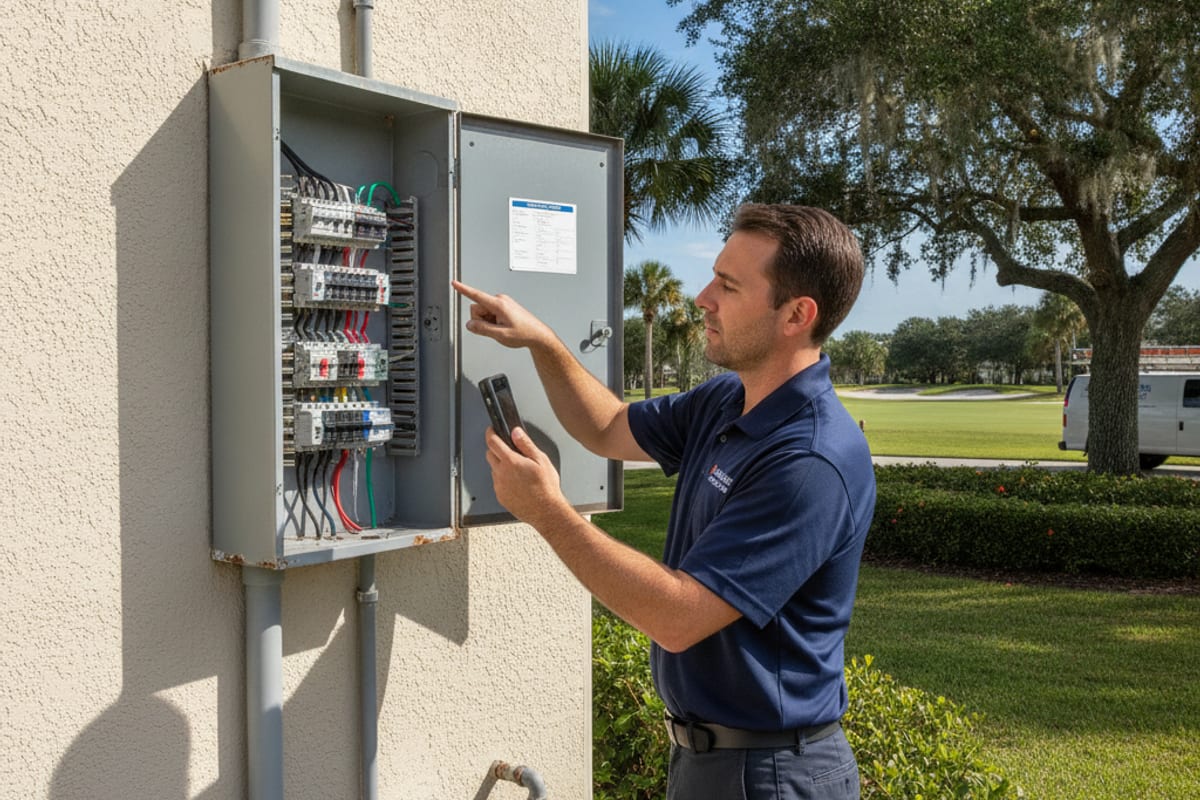
A good contractor’s first step is a site visit to photograph your existing panel, pull the amp rating and main breaker size, and flag whether a panel upgrade is needed before the generator work can proceed safely. If your panel is 100-amp and original to the house, you’ll typically need a 200-amp upgrade as part of the same project. This matters because some contractors avoid mentioning it upfront and then hit you with a change order mid-install.
Transfer switch knowledge matters
A transfer switch is the part that makes a generator safe to use at all. Without one, there’s a real risk of backfeeding power into utility lines that crews expect to be dead. A contractor who can explain automatic versus manual switching, who mentions code-compliant interlocks as a budget option if you’re running a portable generator first, and who ties the transfer switch sizing to your actual panel load is someone who understands the full picture.
If a contractor can’t clearly explain what a transfer switch does, that’s a flag. Most Palm Harbor homeowners running standby systems will have an automatic transfer switch, and a contractor who’s done this work more than a few times in Lansbrook or East Lake can walk you through it in plain language.
Get a real load calculation, not a guess
Before sizing any generator, someone should ask you about your existing electrical load, your cooling load, and what systems you’re running that need to stay on during an outage. A formal load calculation is a documented process that accounts for all of this, and it’s the basis for choosing whether you need a 16 kW, 20 kW, or 24 kW unit. A contractor who quotes a generator size without ever asking about your home’s actual loads is making a guess that sometimes gets expensive mid-storm.
This is especially important in Lansbrook and East Lake, where properties often run pool equipment, irrigation systems, backup sump pumps, and smart-home controls that all add to the total load. An undersized generator leaves you with circuits still dark during an outage, an oversized one costs more money upfront and burns extra fuel.
Compare estimates, but don’t chase the lowest price blind
Generator quotes in Palm Harbor can vary by $3,000 to $5,000 for what sounds like the same installation, because the real difference is in engineering details. Is the panel upgrade included or listed separately? Is the transfer switch quoted as automatic or manual? What about the generator’s warranty extension, fuel tank upgrade, weather enclosure? A quote that’s dramatically lower than two or three others usually leaves something out, and it often shows up as a change order once the crew is on-site and the panel is open.
Ask every contractor in writing: “What’s included in this price? What requires a separate permit or inspection? What happens if the panel needs an upgrade? When does payment come due?” Don’t assume the cheap bid is the smart bid.
Signs of a contractor worth keeping
A few things separate a solid generator contractor from a one-off job: they ask what systems you need to stay on during an outage before sizing the unit. They pull permits without being asked. They provide a written estimate that itemizes the transfer switch, the generator, the panel work (if needed), and the installation labor separately. They flag HOA and permit requirements upfront, not mid-project. And they stand behind the work with a real warranty, not just a handshake.
In Lansbrook and East Lake, a good contractor also knows the utility companies’ interconnection requirements and the typical HOA architectural review timeline, and they factor both into the project schedule.
What to ask before you hire anyone
A short list to work through during your estimate: What’s your Florida license number, and can I verify it? Will this job require a Pinellas County permit and inspection? Do you think my panel needs an upgrade? Have you done work in Lansbrook or East Lake before? What’s your automatic transfer switch brand and model? Will you file for HOA architectural review, and how long does that usually take? What’s your warranty on the generator and the labor? How do you handle a problem that shows up during startup or the first outage?
We’re here to answer all of it
Every generator contractor we connect you with is licensed to do electrical work across Pinellas County and pulls a permit on every installation. We walk through transfer switch options, flag panel upgrades before they become surprises, and stand behind the full installation with a real warranty. Call us at (813) 850-0320, ask any of the questions above, and we’ll connect you with someone who builds the system right the first time, not the cheap way.
FAQ
Do I need a permit for a whole-home generator in Palm Harbor?
Yes. Pinellas County requires an electrical permit and inspection for any whole-home generator installation with a transfer switch. We pull the permit and schedule the inspection as part of the project.
Will my Lansbrook or East Lake HOA let me install a visible generator pad?
Most gated communities require architectural review for exterior equipment placement. A good contractor will flag this early and file the review as part of the project scope, not leave you chasing approval on your own.
What size generator do I actually need?
That depends on your home’s load, your cooling system’s startup draw, and which systems you need to stay on during an outage. A formal load calculation accounts for all of this. Any contractor who quotes a size without asking about your loads is guessing.
What if my panel is original 1970s service?
Most original 100-amp panels need to be upgraded to 200-amp before a whole-home generator and automatic transfer switch can be safely installed. This usually gets engineered together as one project with the contractor, not added mid-install.
What’s the difference between automatic and manual transfer switches?
An automatic switch detects the outage and switches your generator on in seconds without anyone having to flip a switch. A manual one requires someone to be home and awake to make the switch by hand. Most Palm Harbor homeowners choose automatic because it works even during overnight storms.
Can I install a generator myself or hire a general contractor instead?
No. Generator installation requires a licensed electrical contractor, a Pinellas County electrical permit, and an inspection by a state-certified inspector. This isn’t a DIY project, and using a general contractor instead of a licensed electrician voids warranties and your insurance coverage.