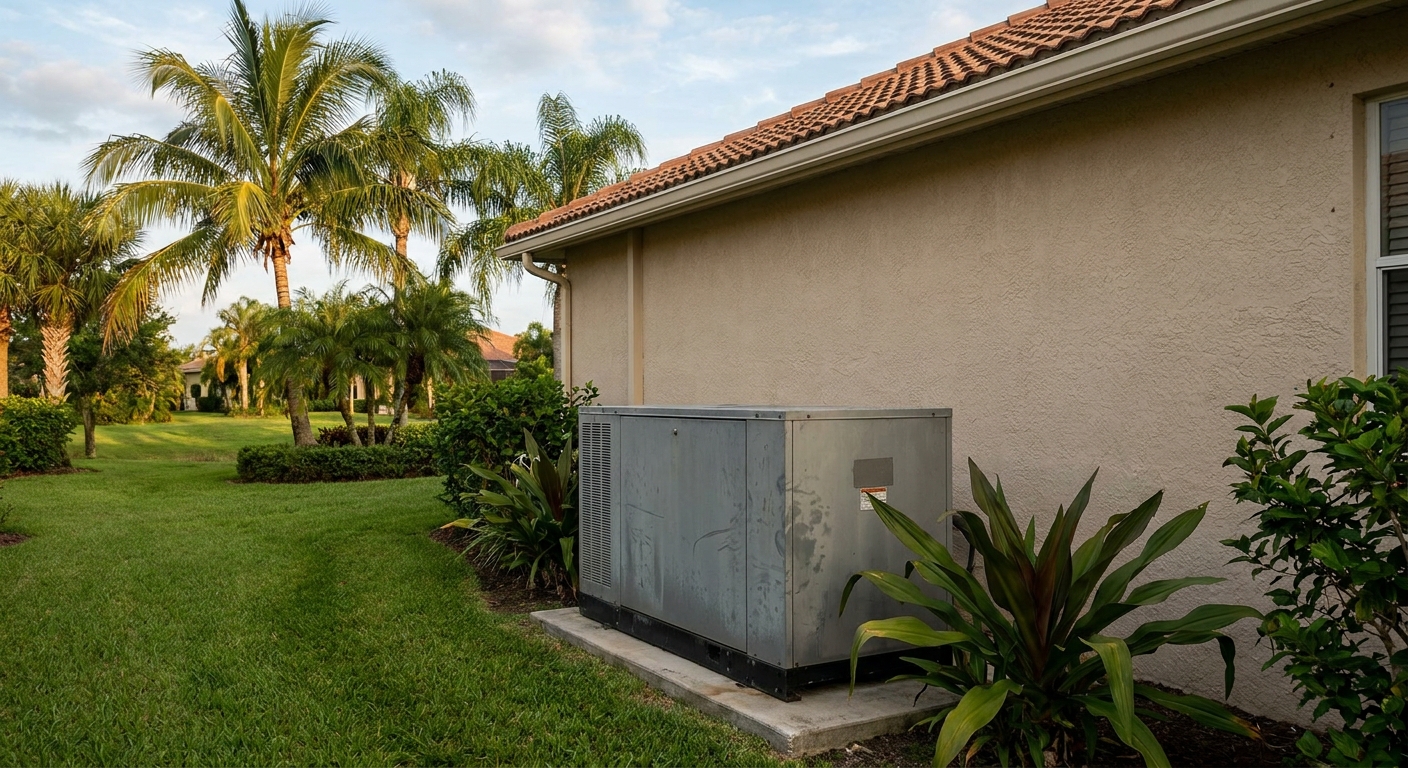
Every June, Tampa Bay homeowners start thinking about generators, and every October a lot of them wish they’d made the call in June instead of during storm week when everyone else has the same idea.
If you’re weighing a whole-home standby generator, here’s what actually matters for a Florida install, not the generic checklist you’ll find on a manufacturer’s site.
Why Tampa Bay specifically needs to think about this differently
Tampa Bay’s power grid takes a real hit during hurricane season, and it’s not evenly distributed. Barrier islands and low-lying coastal areas lose power first and get it back last, because those are the same areas crews can’t safely reach until floodwater and downed lines clear. If you’re on Davis Islands, in Apollo Beach, on Tierra Verde, or anywhere along the immediate coast, you should plan around being without utility power for days, not hours.
Inland neighborhoods fare better on timing but aren’t immune. Lightning alone, and Tampa Bay sees more lightning strikes than almost anywhere in the country, causes plenty of outages with no hurricane involved at all.
Worth knowing before the storm: not every post-hurricane outage is the utility’s to fix. If the weatherhead, riser, or meter box on your wall is damaged, that repair is yours, and the power stays off until it’s done and inspected. That scenario, and the partial outages that come with it, is covered in our guide to half the house losing power.
Whole-home versus portable, quickly
A portable generator runs $500 to $2,000, needs manual setup with extension cords, has to run outside away from windows and doors because of carbon monoxide risk, and covers a handful of circuits at best. A whole-home standby unit installs permanently outside your home, kicks on automatically within seconds of an outage through an automatic transfer switch, and can run your entire house including AC.
For anyone who’s evacuated a portable generator setup during an actual storm, or run one dry at 2am in the rain, the case for a standby unit gets obvious fast. We cover the full comparison in a separate guide if you’re still deciding between the two.
Sizing it right
Most Tampa Bay homes need something in the 18 to 22 kilowatt range to run a full household including central air conditioning, which matters more here than almost anywhere else in the country. Florida heat without AC during a multi-day outage isn’t just uncomfortable, it’s a real health risk for older residents and anyone with medical conditions.
Undersizing is the most common mistake we see from other installers. A generator that can’t handle your AC compressor’s startup surge will trip constantly or shut down when you need it most. We size based on your actual electrical load, not a rule-of-thumb square footage chart.
Fuel type: natural gas versus propane
If your home already has a natural gas line, that’s usually the better call. Natural gas generators pull an unlimited fuel supply straight from the utility line, meaning the generator can run indefinitely as long as the gas grid itself stays up, which it typically does even when the electrical grid doesn’t.
Propane is the fallback for homes without gas service, common in a lot of Pasco County’s more rural areas like Odessa, Land O’ Lakes, and Dade City. Propane requires an on-site tank, usually 250 to 500 gallons for a whole-home unit, and that tank needs refilling, which becomes its own logistics problem if a storm knocks out delivery routes for a week.
What it actually costs
A fully installed whole-home standby generator in Tampa Bay typically runs $8,000 to $15,000, depending on the generator’s size, whether you’re on natural gas or need a propane tank installed, and how much electrical work your panel needs to support the automatic transfer switch. Homes with older panels sometimes need a panel upgrade as part of the job, which we’ll flag during the initial site visit rather than surprising you with it mid-install.
Permitting and inspection
Hillsborough and Pinellas County both require permits for standby generator installation, including electrical and sometimes gas line inspection depending on fuel type. We handle the permit process and schedule inspections as part of the job. Skipping this step isn’t just a compliance issue, it can void your homeowner’s insurance coverage if something goes wrong later.
Maintenance you shouldn’t skip
A standby generator sitting unused for eleven months a year and expected to fire up perfectly during an active hurricane is asking a lot of a machine. Most units need an annual service check, oil changes on gas-engine models, and a self-test cycle that runs automatically on a schedule, usually weekly, to keep the engine from seizing up between real uses. We set that schedule during install so you’re not thinking about it until the annual reminder comes due.
The timing problem
Every June the calls start, and every August the wait times stretch out because everyone waits until a named storm is in the Gulf to make the call. Installation, permitting, and inspection take real time, generally two to four weeks from quote to a working system. If you’re reading this before hurricane season is in full swing, that’s the window to act in.
Get a real quote before storm season peaks
What happens if you skip the automatic transfer switch
Some homeowners try to save money by skipping the automatic transfer switch and manually connecting a large generator during an outage. This is not a safe shortcut. Without a properly installed transfer switch, there’s a real risk of backfeeding power into the grid, which can injure utility workers restoring lines nearby and will void your generator’s warranty and likely your insurance coverage. Every whole-home generator we install includes a code-compliant transfer switch as part of the job, not an optional add-on.
Load management for smaller generators
If budget pushes you toward a slightly smaller generator than your full household load would ideally call for, load management modules are worth considering. These devices automatically shed lower-priority circuits, like a second AC zone or a pool pump, when a higher-priority appliance like your primary AC compressor kicks on, letting a smaller generator cover a bigger house without the risk of overloading it. It’s a way to bridge the gap between budget and coverage without guessing wrong on sizing.
One circuit that shouldn’t be shed is the well pump. On well water an outage costs you water pressure along with everything else, so the pump belongs in the load calculation from the start, and its condition is worth confirming beforehand if the pump has been tripping its breaker.
Call (813) 850-0320 and we’ll walk your property, check your panel and gas service, and give you an honest whole-home generator sizing recommendation and a firm price, not a generic estimate off a spec sheet.