Both of them keep the lights on, and they get there by completely different routes. A standby generator makes its own power from fuel and hands it to your house through transfer equipment that isolates you from the utility. A home battery stores power that was already made, usually by rooftop solar, and releases it through an inverter that has to be approved and interconnected by Tampa Electric before it is allowed to run. The generator question is mostly about fuel, siting and transfer. The battery question is mostly about paperwork, inspection and a specific switch on your wall.
Neither is the obvious winner. What usually decides it is what is already on the property and how much room the electrical service has left.
Solar by itself goes dark when the grid does
This surprises people every storm season, and it is worth saying plainly before anything else. Tampa Electric puts it this way: “during a power outage, a grid-tied solar system alone will not provide power to your home or business; they are designed to shut off when the grid goes down.” The reason is not a product flaw. As the utility explains on its storage page, “This is a safety requirement that prevents your system from back-feeding electricity onto the grid and electrocuting line workers.”
So a roof covered in panels is not backup power. If outage coverage is the goal, the battery is the part that does that job, and the panels just refill it. Tampa Electric also notes you can install a standalone battery without solar, “though it won’t save you as much money.”
For a sense of scale, the utility publishes one figure: “A typical 13.5 kilowatt-hour (kWh) storage installation in Florida costs about $14,000 and lasts about 10 years.” That is Tampa Electric’s own published estimate for the equipment, not a quote from anyone, and it says nothing about what your particular installation and electrical work would come to.
What Tampa Electric requires before a battery runs
A home battery is not a plug-in appliance. Tampa Electric states flatly that “You will be required to interconnect your home battery system,” and it publishes a battery interconnection agreement covering “interconnected customer-owned battery subsystems 1 kW or more” at Section 8, sheet No. 8.1150 of its tariff. That threshold is low enough that essentially any real whole-home battery lands inside it.
Three of the requirements on the utility’s steps to connect page are electrician work, and they are the reason a battery project stalls more often than it fails:
- A manual disconnect switch of visible load break type must be installed adjacent to the meter, before the inspection happens, and it has to carry a placard engraved or stamped ON-SITE GENERATION UTILITY DISCONNECT SWITCH. A photo of that switch and placard goes in with the application.
- Proof of inspection and approval by the local code authority is required, which means the jurisdiction your address actually sits in rather than whichever city shows up on your mail.
- Proof of insurance is required, and Tampa Electric sets the floor by size: “For battery installations at or below 15 kW AC maximum capacity, proof of insurance not less than $100,000 general liability insurance for personal injury and property damage,” rising to $1,000,000 above 15 kW AC.
After all that, the clock still runs. The utility says “The interconnection approval process may take up to 30 calendar days from the date Tampa Electric receives a completed application and all required documentation,” and that “Approval is also dependent on a successful inspection performed by Tampa Electric, including verification of an acceptable disconnect switch.” A battery sitting on the garage wall with no approved disconnect beside the meter is a battery that does not legally run.
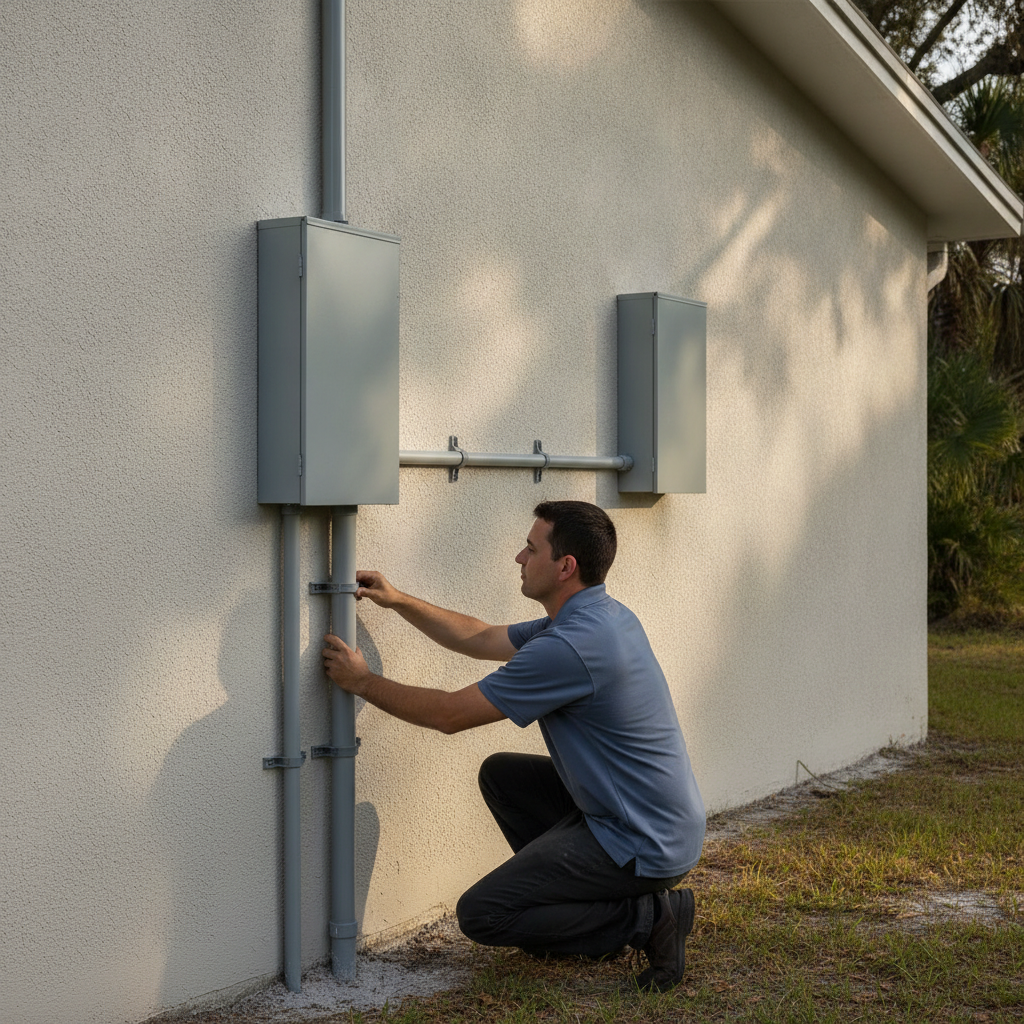
That disconnect location matters more than it sounds. It goes next to the meter, which on most Tampa Bay houses means the exterior wall facing the side yard, often the same stretch of block wall carrying the service riser. If that wall is crowded, behind a fence, or has an AC condenser pad in front of it, resolving the clearance is part of the job rather than an afterthought. The same question comes up whenever anything gets added near the service equipment, which is why who owns and replaces the meter box is worth understanding before a crew shows up.
What a standby generator needs instead
A standby generator skips the interconnection file and picks up a different set of problems. It burns fuel, so it has to live outdoors on a pad with manufacturer clearances respected and exhaust pointed away from windows and soffit vents. It needs transfer equipment that physically isolates the house from the utility, because connecting a generator to house wiring without that isolation pushes power back out toward line crews. And it needs a decision about scope: whole house, or a transfer switch feeding a defined list of circuits.
That essential-load list is the conversation most homeowners have not had yet. Writing it down in May, at the kitchen table, is a lot calmer than guessing in August. The refrigerator, a few outlets, the well pump if you are on one, and the air handler are usually where it starts. Our walkthrough of whole-house versus portable generators in Florida covers how that list changes the size of the machine, and the whole-home generator service page covers what the installation itself involves.
One thing a generator does not do is reduce what your electrical service has to carry. Backup equipment supplies power during an outage; it does not create circuit space or raise your service capacity. Those are separate problems with separate fixes.
How the two compare
| Home battery | Standby generator | |
|---|---|---|
| Where the power comes from | Stored energy, refilled by solar or the grid | Fuel burned on site |
| Utility involvement | Interconnection agreement, utility inspection, approved disconnect at the meter | No interconnection filing, but transfer equipment must isolate the house |
| What sits outside | Inverter and disconnect near the meter, battery often in a garage or on a shaded wall | Equipment on a pad with clearance and exhaust routing |
| Noise and exhaust | Silent, no combustion | Engine noise and combustion exhaust whenever it runs |
| Runtime limit | Capacity of the battery and whether the sun comes back | Fuel supply and maintenance |
| Typical electrical work | Disconnect, circuit routing, often a critical-loads subpanel | Transfer equipment, pad feed, often a subpanel |
Read that table as a description of the decisions, not a scorecard. A household on a well in Odessa with a long driveway and propane already on site leans one way. A Hyde Park bungalow with solar already on the roof and no room for a generator pad leans the other.
The part both options share
Whichever one you pick, it lands on your panel, and your panel is usually what decides how hard the job gets. Both setups commonly want a critical-loads subpanel so the backed-up circuits sit together instead of being scattered across a main panel. Both need somewhere to land new conductors. And on a service that is already full, adding either one turns into a two-stage project where the panel upgrade happens first.
Tampa Electric says the same thing from its side about electrification generally: “You may need to upgrade your electrical panel to support higher loads when electrifying your home.” A load calculation is how that question gets answered with numbers instead of opinion, and it is worth doing before you pay for equipment that your service cannot comfortably take.
Surge protection belongs in the same conversation. Equipment with power electronics in it sits on the service all year in a part of the country that gets a lot of lightning, and whole-house surge protection is cheap insurance next to an inverter. Our post on surge protection in the lightning capital goes into why the Tampa Bay pattern is different from most of the country.
Frequently asked questions
Can I add a battery to solar panels I already have?
Yes, and Tampa Electric describes it as a normal path: you can add a battery to an existing solar panel system rather than installing both at once. The interconnection requirements still apply to the battery, including the disconnect switch adjacent to the meter and proof of local code approval, so it is a permitted project rather than an equipment swap.
Does a standby generator need utility approval like a battery does?
A standby generator is not filed as an interconnected generating system the way a battery or solar array is, because it is not sending power to the grid. What it does need is transfer equipment that isolates your house from the utility while it runs, plus whatever permit and inspection your local jurisdiction requires. Turning off the main breaker is not a substitute for proper transfer equipment.
Where does the utility disconnect switch have to go?
Tampa Electric requires a manual disconnect switch of visible load break type installed adjacent to the meter, in place before the inspection, with a placard reading ON-SITE GENERATION UTILITY DISCONNECT SWITCH. A photo of it goes in with the interconnection application. The practical consequence is that the wall around your meter needs to be reachable and clear, which occasionally means moving something else first.
When to call us
Both of these projects start the same way, with an honest look at the service and the panel, and that is licensed electrician work rather than something to settle from a product page. If you are weighing a battery against a generator, or you have equipment on order and need the disconnect, the subpanel and the inspection handled in the right order, the licensed electricians in our Tampa Bay network can walk the property and scope it. Call us at (813) 850-0320.