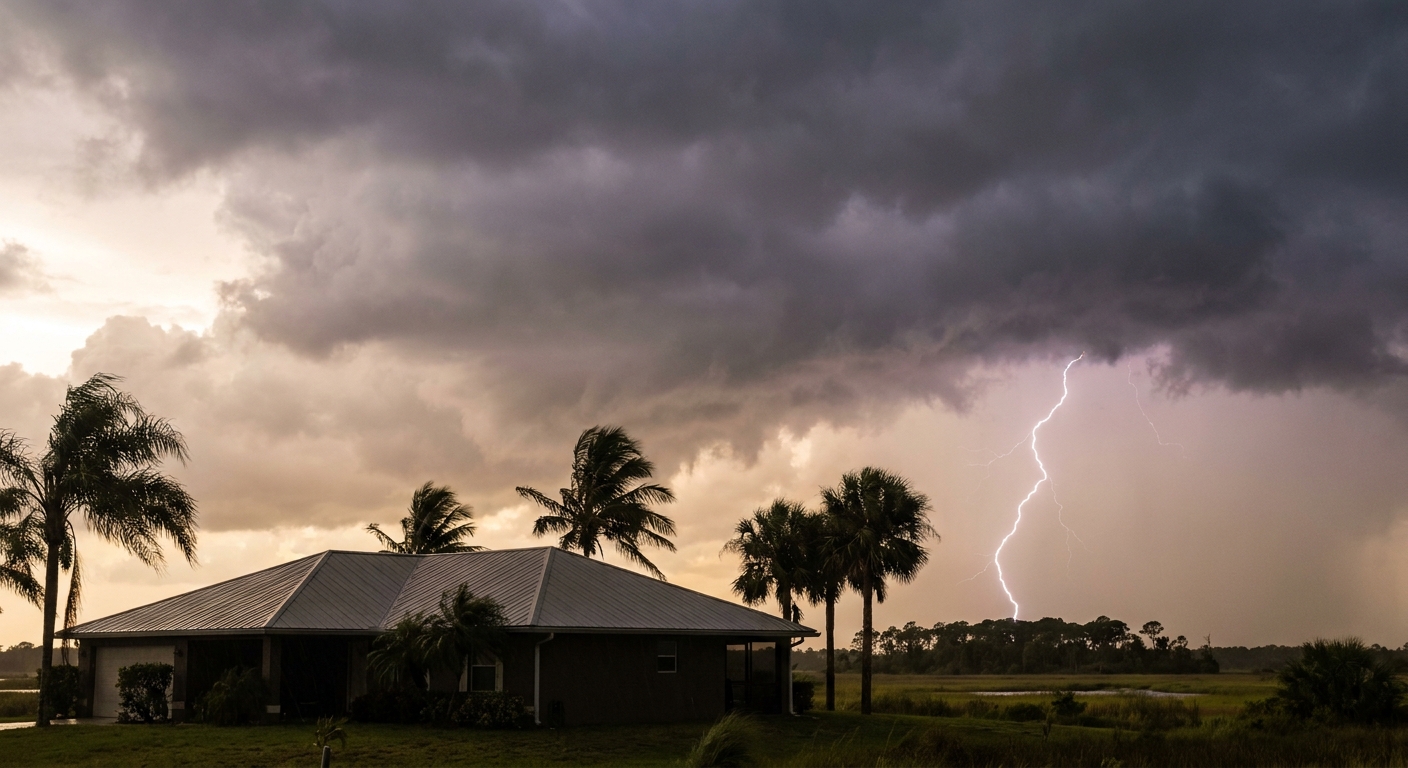
Tampa Bay has a nickname that’s not exactly a point of pride if you’re a homeowner: the lightning capital of the United States. The average property here sees somewhere between 10 and 15 strikes a year within a half mile radius. That’s not a once-in-a-decade event, it’s basically a weekly summer occurrence during storm season.
Most homeowners think about lightning as a roof-and-fire risk and stop there. The bigger everyday cost is quieter: fried electronics, dead appliance boards, and HVAC control systems that die months after a storm nobody remembers because the damage was gradual, not dramatic.
How lightning actually damages your home without a direct hit
A direct strike on your house is rare and dramatic. What happens far more often is a nearby strike, sometimes a mile or more away, that sends a surge racing down the power lines into your home’s electrical system. That surge doesn’t need to hit your house to hurt it. It travels through the grid and into your panel, then out to every outlet and hardwired appliance in the building.
Modern homes have a lot more at stake than they did thirty years ago. Refrigerators, washers, dryers, HVAC systems, and water heaters all run on circuit boards now instead of simple mechanical switches, and those boards are exactly what a surge takes out first. A/C control boards in particular are a common casualty in Tampa Bay, and replacing one runs several hundred dollars on top of the diagnostic visit.
Plug-in surge protectors aren’t enough
A power strip labeled “surge protector” at the big box store protects whatever’s plugged into it, and that’s it. It does nothing for your HVAC system, your water heater, your dishwasher, or anything else hardwired into the house. It also has a limited lifespan, degrading with every surge it absorbs, often silently, until it’s providing no protection at all while still lit up green.
What whole-house surge protection actually does
A whole-house surge protective device, sometimes called an SPD, installs directly at your electrical panel and protects everything downstream of it, every circuit, every hardwired appliance, every outlet in the house, in one install. When a surge comes in from the grid, the device diverts the excess voltage before it reaches your home’s wiring and equipment.
There are two types worth knowing. Type 1 devices install at the service entrance, ahead of the main panel, and handle the largest external surges, the kind coming from a nearby lightning strike or grid switching event. Type 2 devices install inside the panel and catch smaller surges, including ones generated internally by your own AC compressor or major appliances cycling on and off. Most Tampa Bay homes benefit from a combination setup, and we’ll walk you through what your specific panel and home need.
What it costs
A quality whole-house surge protector unit runs $300 to $600 for the device itself. Installed, including the panel work, typically lands in the $500 to $1,200 range for most homes, depending on panel type and whether any additional grounding work is needed. Compare that to a single AC control board replacement, often $400 to $800 on its own, and the math tends to work out fast, especially in a region getting hit as often as Tampa Bay does.
Where it matters most
Every neighborhood in Tampa Bay sits inside the lightning zone, but a few specific situations raise the stakes further. Homes with newer HVAC systems, tankless water heaters, or smart-home equipment have more circuit-board-dependent appliances exposed to surge damage than older homes with simpler mechanical systems. Homes with a pool, common across South Tampa and Riverview, have pool control panels and pump equipment that are just as vulnerable and just as expensive to replace. And anyone who’s added an EV charger recently has added another piece of expensive, surge-sensitive equipment to the panel.
Insurance and surge protection
Some homeowner’s insurance policies in Florida now ask about surge protection during underwriting, similar to how they’ve started flagging older panels and aging roofs. It’s not universal yet, but it’s trending that direction as insurers look for anything that reduces claim frequency. A whole-house SPD is a relatively low-cost item that can help on that front, on top of the direct protection it provides.
Installing it alongside other panel work
If you’re already having panel work done, a Federal Pacific or Zinsco panel replacement, an EV charger circuit, or a generator transfer switch, adding surge protection at the same time is efficient. It’s a straightforward addition when the panel’s already open, and it’s one more thing you won’t have to think about again once it’s in.
Protect what’s actually in your walls
Ten to fifteen strikes a year within a half mile isn’t a maybe. It’s the baseline for anyone living in Tampa Bay. Whole-house surge protection is one of the lowest-cost, highest-value additions we install, and it’s a same-day job in most homes.
Grounding matters as much as the device itself
A surge protector is only as good as the grounding system it’s connected to. Older Tampa Bay homes, particularly those with original 1960s and 70s electrical, sometimes have grounding that doesn’t meet current code, which reduces how effectively any surge device can do its job. Part of a proper whole-house SPD installation includes verifying your grounding system is adequate, and upgrading it if it’s not, rather than bolting a surge protector onto a foundation that can’t fully support it.
Call (813) 850-0320 and we’ll check your panel and give you a straight answer on what protection makes sense for your home.