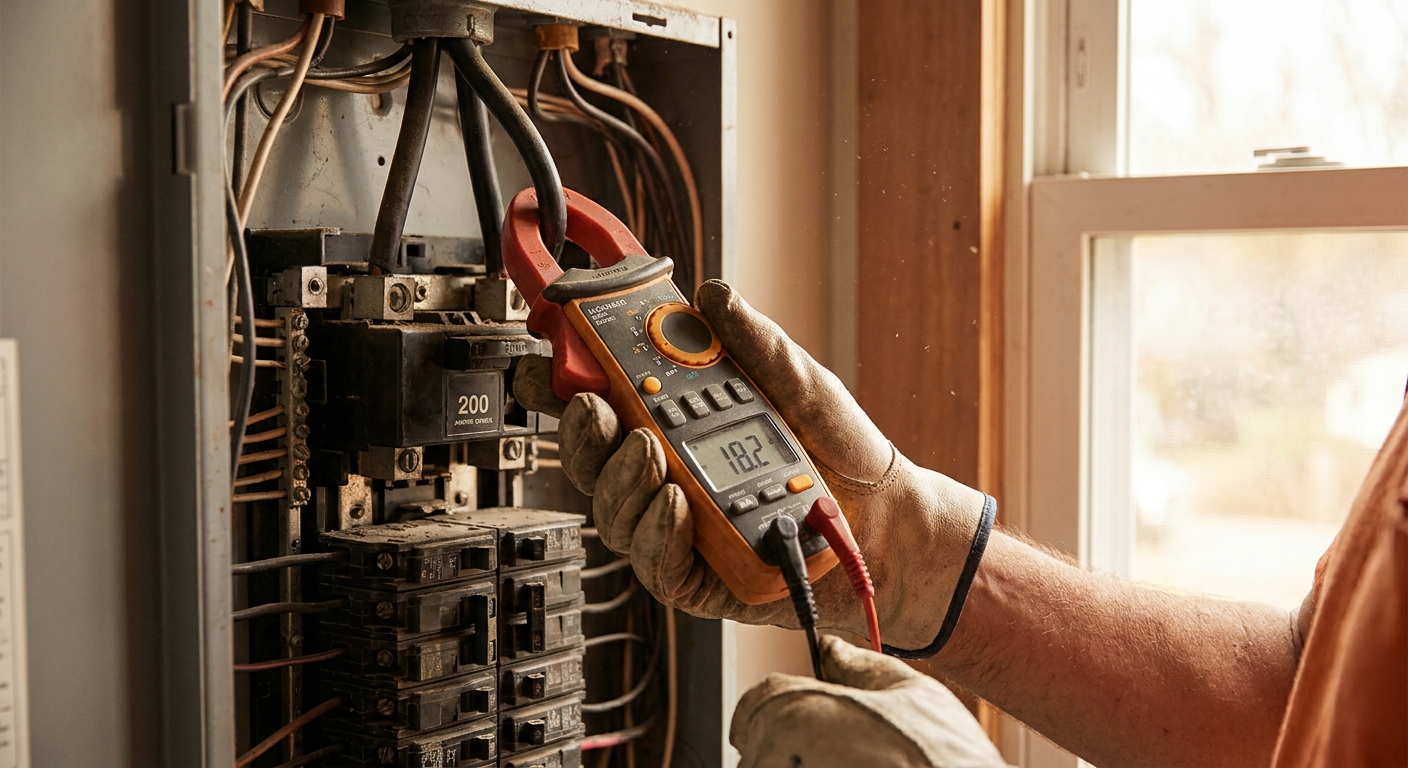
Amperage is the size of the pipe, not the amount of water flowing through it. A 100-amp panel isn’t broken just because it’s 100 amps, but it does put a hard ceiling on how much your house can run at once, and that ceiling is a lot easier to hit in 2026 than it was when most of Tampa Bay’s older housing stock was built.
Why this question keeps coming up
Fifty years ago, a house ran a refrigerator, a window unit or two, some lights, and maybe a washer and dryer. A 60 or 100-amp panel handled that without strain. Now the same house is being asked to run central AC, an electric range, an on-demand electric water heater, a pool pump, an EV charger, and a home office full of electronics, often all from the same panel that was sized for a much lighter load decades ago.
This is a real issue across the region. Seminole Heights, Tampa Heights, and the older cores of St. Petersburg, Old Northeast and Kenwood, still have plenty of homes running on original 60 or 100-amp service from the 1950s and 60s. Carrollwood and Town ‘n’ Country, built out mostly in the 70s through 90s, are more often sitting at 100 amps when 150 or 200 would serve them better today.
What each size actually supports
60 amps is essentially obsolete for a modern home. If you’ve got this, it’s original 1950s-60s wiring that’s never been upgraded, and it’s worth a look regardless of whether you’re adding anything, insurance carriers increasingly flag 60-amp service on renewal.
100 amps handles a smaller home with gas heat, gas water heater, and no major electric loads beyond central AC and standard appliances. It gets tight fast if you add a pool, an EV charger, or an electric range on top of existing AC and water heating. When a panel is already at its limit, the first symptom is often a water heater that keeps tripping its breaker.
150 amps is a reasonable middle ground for a mid-sized home with central AC, standard appliances, and one significant addition like a pool pump or an EV charger, but not both.
200 amps is the standard for new construction across the region right now, and it’s what we recommend for most homes that are adding a pool, an EV charger, a whole-home generator, or planning to electrify anything, water heater, range, in the next several years. It’s the sweet spot for the vast majority of single-family homes in Riverview, Brandon, Valrico, and FishHawk.
400 amps is for genuinely large homes, ones running multiple AC systems, a whole-home generator, an EV charger or two, a pool, and significant square footage, typically 4,000+ square feet. We see this more in Palma Ceia, Avila proper, Tierra Verde, and some of the larger new-construction homes in Lutz and Cheval.
Signs your current panel is undersized
A few patterns show up constantly on service calls:
Breakers trip when you run the microwave and the AC at the same time. Lights dim noticeably when a large appliance kicks on. You’ve been told by an HVAC company, a pool installer, or an EV charger installer that they can’t add the load without a panel upgrade first. Your panel still uses fuses instead of breakers, which usually means you’re well under 100 amps of usable capacity regardless of what the label says. Your homeowner’s insurance flagged the panel brand or age on a recent renewal, Federal Pacific and Zinsco panels in particular get flagged and sometimes require replacement to keep coverage.
The EV and pool trigger
The most common reason we get called out to look at panel capacity right now isn’t a failure, it’s an addition. An EV charger draws a serious continuous load, and a pool pump plus pool heater adds another chunk on top of whatever the house is already running. Wesley Chapel, Riverview, and FishHawk are seeing especially high EV adoption alongside new-build pools, and a lot of those homes were built with 150 or 200-amp service that’s now genuinely full once both get added.
Before you buy an EV charger or sign a pool contract, it’s worth having your panel’s actual available capacity checked, not just the number stamped on the panel door, but what’s actually available after everything currently connected is accounted for. Adding a $1,500 charger only to find out the panel can’t support it without a $3,000 upgrade is a bad surprise to have after the fact instead of before.
What a panel upgrade actually costs and involves
A straightforward 100-amp to 200-amp panel upgrade in the Tampa Bay area typically runs $2,500 to $4,500, depending on panel location, whether the service entrance cable also needs upsizing, and whether TECO or Duke Energy needs to coordinate a meter change alongside the work. Older homes in historic districts like Hyde Park or Ybor sometimes carry a small premium if the panel location requires extra routing to stay code-compliant without altering the home’s exterior character.
A jump to 400 amps, usually done as a service upgrade with a new meter can and sometimes a subpanel setup, runs higher, generally $4,500 to $8,000 depending on the scope.
Either way, this work requires a permit and inspection through Hillsborough or Pinellas County, and it requires the power company to briefly disconnect and reconnect service, so it’s scheduled work, not same-day in most cases.
Find out where you actually stand
Guessing at panel capacity is how homeowners end up mid-project with a pool installer or an HVAC contractor telling them the job’s on hold. Call Tampa Electrical Pro at (813) 850-0320 and we’ll do a load calculation on your actual panel, tell you honestly whether you need an upgrade, and give you a real number before you commit to anything else that depends on it.
Don’t forget the meter and service entrance
A panel upgrade sometimes reveals that the service entrance cable running from the meter to the panel is also undersized for the new amperage. This is standard to check alongside any upgrade, and it’s why an honest quote includes an inspection of the whole service path, not just the panel box itself.