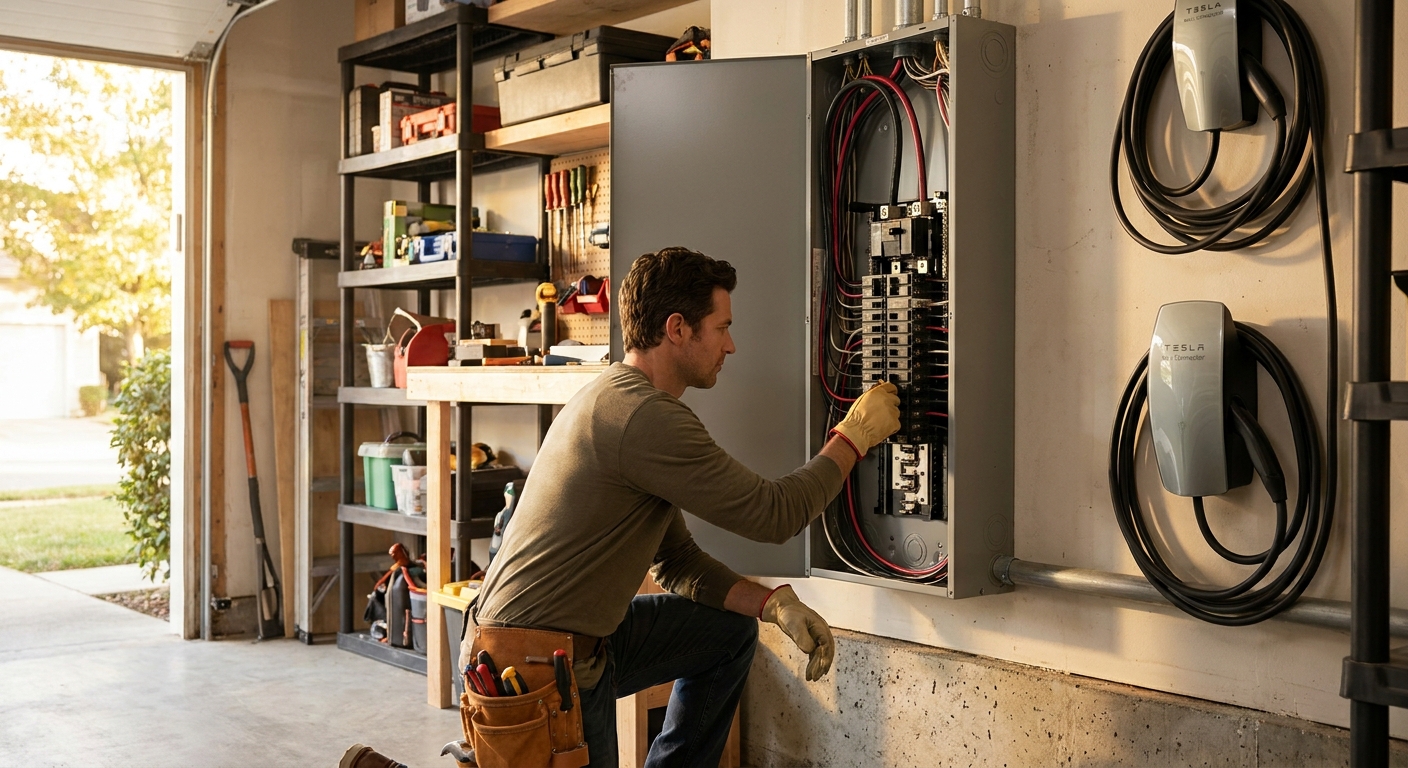
A Level 2 EV charger is the single biggest continuous electrical load most homeowners will ever add to a house. It’s not a toaster running for twenty minutes, it’s 30 to 50 amps pulling steadily for several hours at a stretch, often overnight, every single day. That’s a fundamentally different kind of demand than anything else in a typical home, and it’s why “just plug it in” is almost never actually how this works.
Why EV adoption is accelerating here specifically
Wesley Chapel, Riverview, and the newer master-planned communities in Hillsborough and Pasco are seeing some of the fastest EV adoption in the region, driven by newer housing stock, higher household incomes, and easier commutes to Tampa via I-75 and the Selmon Expressway. South Tampa, Palma Ceia, and Davis Islands are right behind, affluent, environmentally conscious, and often already running Tesla or other EVs as a second or third household vehicle.
The problem is that a lot of these homes, especially anything built before 2015, weren’t designed with EV charging load in mind, which means the panel question comes up almost every time.
Level 1 versus Level 2, and why Level 2 is what people actually want
Level 1 charging uses a standard 120-volt outlet, the kind you already have in the garage, and it’s genuinely too slow for most people, adding roughly 3 to 5 miles of range per hour. That works if you drive under 30 miles a day and never need a fast top-off. Most people don’t want to live with that constraint.
Level 2 charging needs a dedicated 240-volt circuit, similar to what an electric dryer or range uses, and delivers 20 to 30+ miles of range per hour depending on the charger and vehicle. This is what almost everyone ends up installing, and it’s the reason the panel conversation matters.
What we check before recommending anything
Available panel capacity. This is the first and most important question. We run an actual load calculation, not a guess, factoring in your existing AC tonnage, water heater, range, pool equipment if you have one, and everything else already on the panel. A 200-amp panel in a mid-sized South Tampa home often has room. A 100-amp panel in an older Carrollwood or Seminole Heights house frequently does not, especially once central AC and an electric water heater are already accounted for.
Panel age and condition. Older panels, particularly anything from before the 1990s, sometimes can’t safely accept a new large breaker even if the amperage math technically works, due to breaker slot availability or general panel condition. Federal Pacific and Zinsco panels in particular are a hard no for adding EV charging load without replacement first, these panel brands have known safety issues independent of the EV question.
Distance from panel to charger location. Most people want the charger in the garage near where the car parks, which is usually close to the panel. But homes with detached garages, common in some of the older Hyde Park and Seminole Heights lots, or a preference for charging near a driveway instead, sometimes need a significant conduit run. That adds cost but isn’t a dealbreaker.
Breaker sizing for the specific charger. Most Level 2 home chargers need a 40, 50, or 60-amp dedicated circuit depending on the model and charging speed you want. This isn’t a place to undersize to save money, an undersized circuit either won’t support full charging speed or, worse, runs hot under continuous load.
The three outcomes of a panel assessment
If the panel has room, it’s a straightforward dedicated circuit install, typically one day, $600 to $1,200 depending on distance and complexity.
If the panel is close but not quite there, sometimes a subpanel dedicated to the garage or a load management device solves it without a full panel replacement. Load management devices actively monitor total home usage and throttle EV charging during peak demand rather than requiring more raw capacity, a good option when a full panel upgrade isn’t in the budget.
If the panel is genuinely maxed out or outdated, a panel upgrade comes first, typically to 200 amps, before the EV circuit goes in. This is more common than people expect in homes built before 2000, which describes a large share of South Tampa, Seminole Heights, and older St. Petersburg housing.
Permits matter here, don’t skip them
EV charger installations require an electrical permit through Hillsborough or Pinellas County in almost every case, and for good reason, this is a high-load circuit that needs to be sized and installed correctly. Unpermitted EV charger work is one of the more common issues we get called to fix after the fact, usually because a circuit was undersized or a breaker wasn’t rated for the continuous load an EV actually draws. It also becomes a real problem at resale, an unpermitted electrical addition can hold up a closing.
What it typically costs start to finish
For a home with adequate existing panel capacity, a dedicated Level 2 charging circuit runs $600 to $1,200 installed, including permit. Add a panel upgrade to that and you’re looking at $3,000 to $5,500 total for panel plus circuit. Load management devices as an alternative to a full panel upgrade generally add $800 to $1,500 to the circuit install cost but avoid the larger panel replacement expense.
Get the panel checked before the charger shows up
Ordering an EV charger before you know what your panel can actually support is how projects stall out mid-install. Call Tampa Electrical Pro at (813) 850-0320 and we’ll run the load calculation, tell you exactly what your home needs, and get the charging circuit installed correctly and permitted the first time.
Searching for EV charger installation near me in Tampa Bay? That’s exactly what we do.
Consider future needs, not just today’s car
If you’re planning to add a second EV down the road, or you know a pool or generator is coming in a year or two, it’s worth sizing the panel upgrade for that future load now rather than paying for the disruption twice. A slightly larger upgrade today is almost always cheaper than two separate jobs.