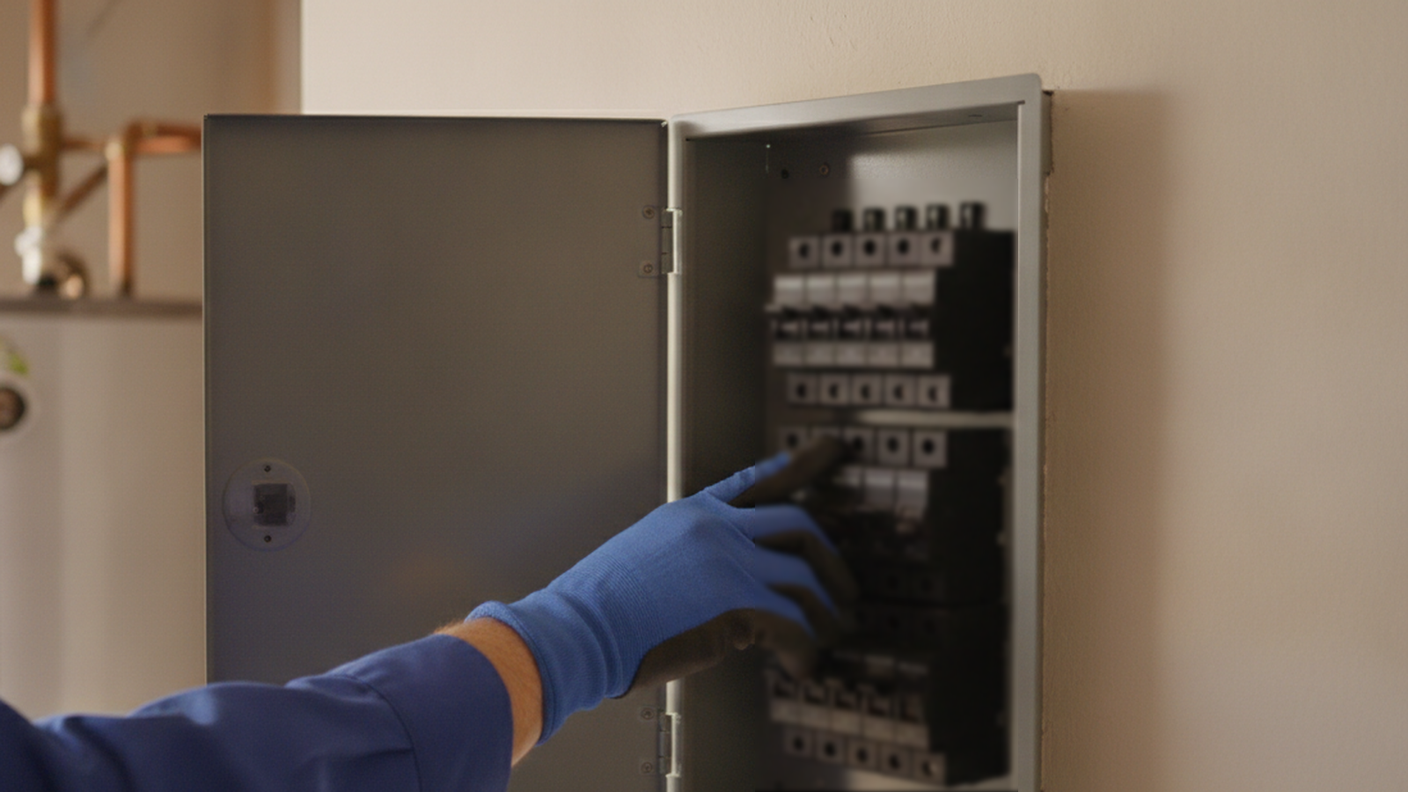
When a water heater keeps tripping the breaker, the breaker is reporting a fault, not causing one. Something on that circuit has changed. The fault sits in one of three places: inside the heater, in the wiring and connections feeding it, or at the breaker and the panel. Testing separates those three before anybody buys a part. There’s a fourth thing worth knowing in Florida: this one fault can land on two different sections of a 4-point insurance inspection.
Water heater keeps tripping breaker: what does that actually mean?
It means the circuit isn’t behaving the way it used to. Resetting the breaker might bring the hot water back, but it doesn’t tell you a thing about why it quit.
The fault can sit in three different places:
| Possible location | What needs to be separated |
|---|---|
| Inside the water heater | A problem within the tank or its controls |
| Wiring and connections | Damage, looseness, overload, or a ground fault |
| Breaker and panel | A failed breaker, damaged panel, or capacity problem |
Don’t let anyone rank those three for you before testing. No symptom on its own proves which branch is responsible.
That split matters because two trades can end up involved. What’s inside the tank is a plumbing question. The branch circuit, the breaker, the connections, and the panel are an electrician’s.
An electrical repair visit is what tells you which side the fault is on. That’s what keeps a breaker swap from turning into an expensive guess.
Our guide to why breakers keep tripping in Tampa covers the broader circuit question. If you’re on a well, the well pump breaker guide walks through the same problem on a different appliance.
Can I just swap the breaker?
No, not until someone diagnoses why the circuit failed. A different breaker won’t correct damaged wiring, overloads, loose connections, or ground faults.
Replacing a breaker to silence trips on a genuinely overloaded circuit removes the warning and leaves the hazard sitting there. You haven’t fixed anything. You’ve just stopped hearing about it.
The breaker itself might genuinely be the problem, and sometimes it is. Testing settles that before anybody picks a replacement. Our circuit breaker replacement cost guide covers why the panel’s condition can change the whole scope of that job.
The permit question doesn’t go away either. Hillsborough County’s exempt-work list carries nothing that covers this kind of panel work, and swapping the part doesn’t turn the job into exempt work.
When does the problem need urgent electrical help?
A burning smell or real heat at the panel is a call for an emergency electrician, not a troubleshooting appointment next week. Those signs take the problem out of the routine column.
The electricians in our network can test the circuit and the panel. They’ll also tell you plainly when what’s inside the heater needs a plumbing professional instead.
Don’t treat a reset as a repair. Every reset leaves the original cause exactly where it was. The next useful step is a test, not another guess.
Why can this affect two parts of a Florida 4-point inspection?
Because the heater and the breaker are inspected separately. That split comes straight off the current Citizens Property Insurance 4-Point Inspection Form, edition marker Insp4pt 03 25.
The plumbing section is where the heater lives. It asks “Is there a temperature pressure relief valve on the water heater?”, records the “Age of water heater”, and states its scope as “Plumbing: Water heater (incl TPRV), under cabinet plumbing/drains, exposed valves”.
The breaker lives somewhere else entirely. “Tripping breakers” and “Improper breaker size” are both printed checkboxes in the electrical section’s Hazards Present grid, sitting alongside “Double taps” and “Over fusing”.
Citizens states, “The Florida-licensed inspector is required to certify the condition of the roof, electrical, HVAC and plumbing systems.” The form defines acceptable condition as “each system is working as intended and there are no visible hazards or deficiencies”.
Its agent instruction is also direct: “Agents may not submit applications for properties with electrical, heating or plumbing systems not in good working order or with existing hazards/deficiencies.”
None of that predicts what any carrier will decide about your house. It’s why getting the diagnosis documented is worth more than getting the breaker quiet. One unresolved fault can show up under two of the four inspected systems.
Our Florida 4-point electrical inspection guide explains the electrical section in more detail.
Does Hillsborough County require a permit for this work?
Yes, and this one isn’t close. Hillsborough publishes exactly one electrical exemption, and it’s this:
“Low-voltage systems: The installation or repair of a low-voltage system in an existing single-family residence when the work is performed by the property owner or the work is performed by a non-owner, provided the total cost of labor and materials does not exceed $5,000”
A water heater branch circuit isn’t a low-voltage system, so that exemption doesn’t reach the repair at all.
The county also spells out when Florida’s residential exemption doesn’t apply. One of the disqualifying conditions is this: “The work includes electrical, plumbing, structural, mechanical or gas work”.
A water heater replacement is both electrical and plumbing work. It’s excluded twice over, and no dollar amount changes that.
We publish electrical permit fees of $75-$150 for Hillsborough and Pinellas, and that’s a planning range rather than a county quote. Only the Hillsborough page was read for this post, so Pinellas and Pasco homeowners should confirm the requirement with their own permitting office.
The same referral network covers Brandon and the rest of Tampa Bay.
What does a diagnostic visit cost?
A service call or diagnostic fee runs $75-$150, and it’s usually credited toward the completed repair.
Electrical repair including that diagnostic visit runs $150-$450. Those are the published ranges for the electrical investigation, not a promise about every outcome behind it.
We don’t publish a flat price for a water heater circuit, a breaker, an element, a thermostat, or the heater itself, because there isn’t an honest one to publish. The real number comes after someone opens the panel and tests the circuit.
The final scope depends on where the fault is found:
- A circuit or connection problem stays within electrical repair.
- A problem inside the tank moves to the plumbing side.
- A damaged, obsolete, or undersized panel becomes a larger electrical project.
Splitting it that way keeps somebody else’s job out of your estimate. It also stops a tidy breaker quote from quietly hiding a much bigger problem.
When does this become a panel problem?
It becomes a panel job when testing turns up damage, obsolete equipment, or a panel that simply doesn’t have the capacity anymore. An electric water heater is one of the big loads that pushes an older Tampa Bay panel past what it was sized for.
Houses keep gaining loads long after the panel goes in. Central cooling, more appliances, more circuits, and the math that worked when the panel went in stops working. Our guide to how many amps a home needs walks through that load-creep problem.
A standard 100-to-200-amp panel upgrade runs $2,500-$4,500. Don’t read that as the likely ending to every tripping water heater, because it isn’t.
The useful decision comes after testing:
- Repair the circuit when the panel remains suitable.
- Address the heater when the fault sits inside the tank.
- Discuss a panel upgrade when the panel is the real constraint.
Who should I call first?
Call an electrician when the breaker, the branch circuit, the connections, or the panel need testing. Call a plumbing professional once the fault is confirmed inside the tank.
The Citizens form draws that same line. The heater sits under plumbing and the tripping breaker sits under electrical, which is the same line your repair follows once the test points to a side.
Tampa Electrical Pro connects homeowners across Hillsborough, Pinellas, and Pasco with licensed electricians available 24/7. Call (813) 850-0320 to request help with the electrical side.
Frequently asked questions
Why does my water heater keep tripping its breaker?
Something’s changed inside the heater, along its circuit, or inside the panel. Testing has to separate those three before anyone can name the repair honestly.
Will replacing the breaker fix the problem?
Only if testing confirms the breaker itself failed. A new one won’t fix damaged wiring, overloads, loose connections, or ground faults.
How much does electrical diagnosis cost?
A service call or diagnostic fee runs $75-$150, and it’s usually credited toward the repair. Electrical repair including that diagnosis runs $150-$450. There’s no published flat price for the water heater circuit itself.
Does a water heater circuit repair need a Hillsborough permit?
Hillsborough’s exempt-work list carries nothing that covers a water heater branch circuit. Its only electrical exemption is for qualifying low-voltage systems, and this isn’t one.
Can a plumber repair the tripping breaker?
No. The breaker, the wiring, the connections, and the panel are electrical work. What’s inside the tank goes to the plumbing side once diagnosis identifies it.
Can this appear on a Citizens 4-point inspection?
Yes. The current form puts the water heater under plumbing and lists “Tripping breakers” among the electrical hazards, so one unresolved fault can show up in two sections at once.