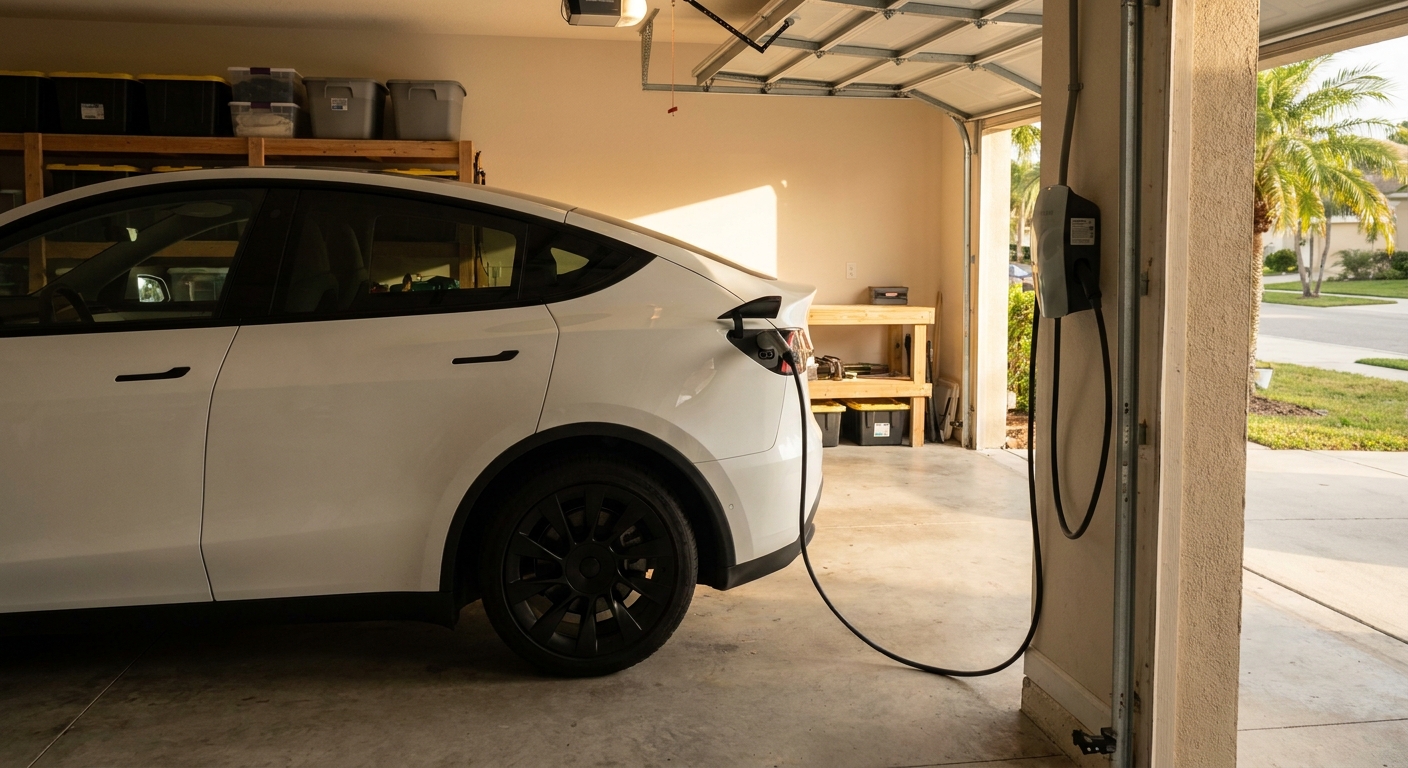
More Tampa Bay driveways have an EV parked in them every year, and the question we hear most from homeowners in New Tampa, Wesley Chapel, and FishHawk is simple: what does it actually cost to charge that thing at home instead of hunting for a public station.
Here’s the real breakdown, not a marketing range pulled from a national average that doesn’t account for Florida homes.
The short answer
Most Tampa Bay homeowners land somewhere between $1,200 and $2,800 for a complete Level 2 charger installation, wall unit included. Where you fall in that range depends almost entirely on one thing: whether your existing panel has room for a new 240-volt circuit, or whether it needs an upgrade first.
Why panel capacity is the real cost driver
A Level 2 charger needs a dedicated 240-volt circuit, usually on a 40 to 60 amp breaker depending on the charger and your vehicle’s charging speed. If your panel has open slots and enough headroom on your main service, that’s a straightforward job: run the wire from the panel to the garage or driveway, install a breaker, mount the charger, and you’re done. That’s the low end of the range, typically $1,200 to $1,800.
The problem shows up in older homes still running 100 amp service, which describes a lot of Tampa’s 1960s and 70s housing stock in Seminole Heights, Carrollwood, and Town ‘n’ Country. Add a modern EV charger to a house that’s already running central AC, an electric water heater, and a full kitchen, and you can hit the ceiling of what that panel can safely deliver. In that case you’re looking at a panel upgrade to 150 or 200 amps first, which adds $2,500 to $4,500 to the job before the charger circuit even goes in.
We check your panel’s available capacity before quoting anything, because guessing on this one gets expensive fast.
Garage runs versus long driveway runs
Distance matters too. A charger mounted a few feet from the panel in an attached garage is the cheapest scenario. A charger mounted at the far end of a long driveway, which is common on the larger lots in Odessa, Lutz, and Land O’ Lakes, means more conduit, more trenching if it’s running underground, and more labor. That can add a few hundred dollars depending on the run.
Permits in Hillsborough and Pinellas
EV charger circuits require an electrical permit in both Hillsborough and Pinellas County, and the inspection isn’t optional if you want the work to hold up for insurance or resale purposes. We pull the permit and schedule the inspection as part of the job, so you’re not left holding paperwork you don’t know what to do with. Permit fees typically run $75 to $150 depending on the municipality.
HOA rules in master-planned communities
If you’re in a newer master-planned community like Seven Oaks, Bexley, Waterset, or FishHawk, check your HOA’s architectural guidelines before you commit to exterior mounting. Most HOAs in these communities don’t block EV chargers outright since Florida law actually protects a homeowner’s right to install one, but plenty require the unit to be mounted in a way that’s not visible from the street or painted to match the home. Worth a five-minute email before installation day so nobody’s redoing conduit later.
Coastal and salt-air considerations
If you’re charging outdoors near the water, in Apollo Beach, Tierra Verde, or anywhere along the Pinellas coastline, salt air corrodes outdoor electrical hardware faster than inland installs. We use corrosion-resistant hardware and weatherproof enclosures on any charger mounted outside in a coastal zone, and it’s worth asking about specifically if your installer doesn’t bring it up first.
What kind of charger you actually need
Most homeowners overthink the charger unit itself. A basic Level 2 unit from a reputable brand runs $400 to $700 and charges most EVs from empty to full overnight, which is all anyone actually needs for daily driving. Smart chargers with app connectivity and load management cost more, generally $600 to $1,000, and make sense if you’re also running a generator or want to avoid tripping your main breaker during peak usage. We’ll tell you honestly if you need the upgrade or if it’s just a nice-to-have.
Rebates and incentives
Federal tax credits for home EV charging equipment have changed more than once in recent years, so check current eligibility before you install rather than after. TECO has run incentive programs for EV charging in the past as well. We can point you toward what’s currently active when we quote the job, since these programs shift.
The generator question
If you’re already thinking about a whole-home generator for hurricane season, mention it when you call about the charger. Sizing an EV charger circuit and a generator transfer switch together, rather than as two separate projects six months apart, can save you a return trip and sometimes a second panel modification.
Getting an accurate number for your home
Every one of these variables, panel capacity, run distance, mounting location, coastal exposure, changes the final price. The only way to get a real number instead of a guess is to have someone look at your actual panel and your actual garage or driveway.
Single charger versus multi-vehicle households
More Tampa Bay households are running two EVs now, which changes the math. A single charger circuit is usually enough if you’re staggering charge times overnight, but some households want two dedicated chargers or a smart charger that load-shares between two vehicles on one circuit. That’s worth discussing up front rather than adding a second charger circuit a year later as a separate project, since running both circuits from the panel at the same time is more efficient than two separate trips.
Call (813) 850-0320 and we’ll walk your property, check what your panel can handle, and give you a firm quote before any work starts.
Searching for EV charger installation near me in Tampa Bay? That’s exactly what we do, every day, across Hillsborough and Pinellas County.