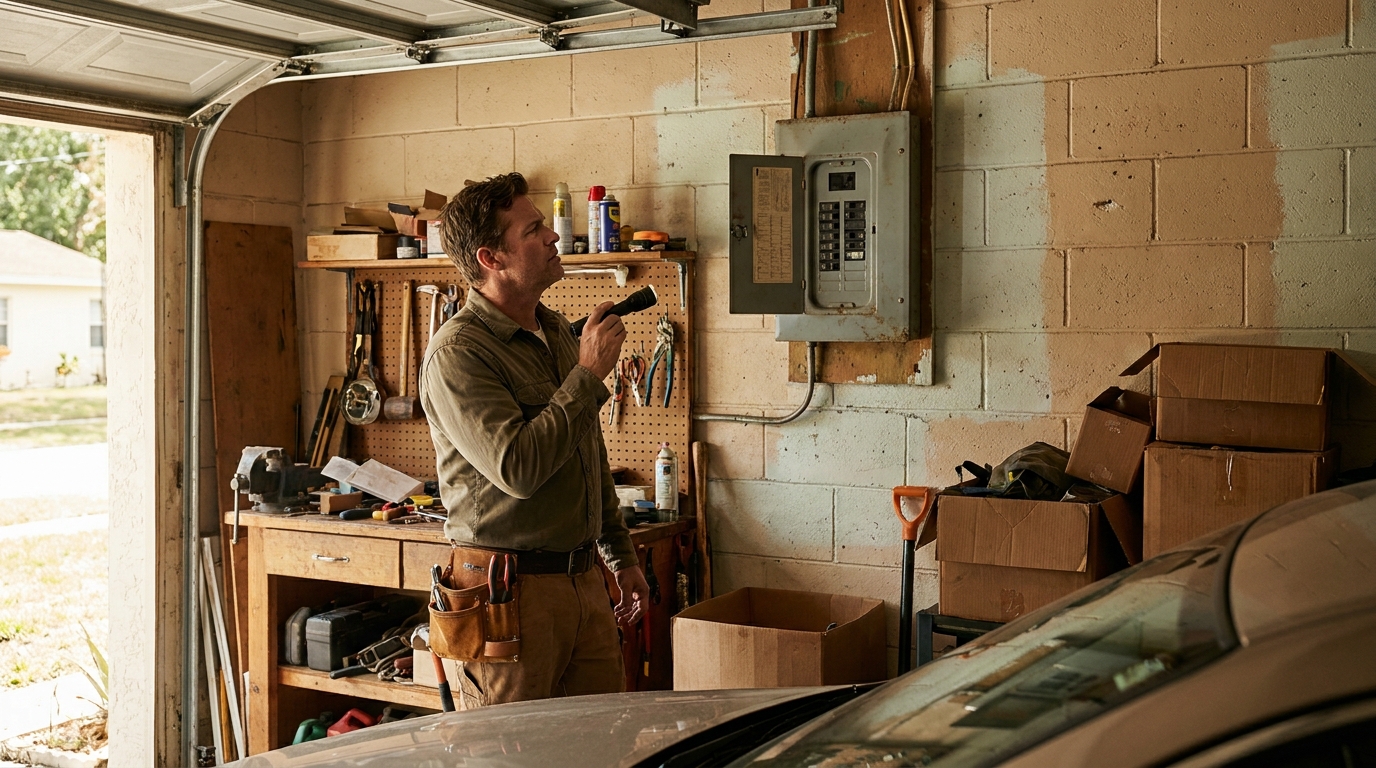
A lot of Tampa Bay homes are quietly running on electrical panels that were sized for a 1970s household, back when nobody had central air, a home office full of electronics, an EV in the driveway, or a pool pump running half the day. If your panel hasn’t been touched since the house was built, there’s a decent chance it’s not keeping up anymore, and the signs are usually there before anything actually fails.
The basic math: how many amps do you have
Look inside your panel door, or check the main breaker at the top. Most homes built before the 1980s were wired for 60 or 100 amp service. Modern homes typically run 150 or 200 amps. If you’re still on 60 or 100 amps and you’ve added central AC, an electric range, a hot tub, or you’re thinking about an EV charger, you’re likely running closer to the edge of that panel’s capacity than you realize.
This shows up a lot in Seminole Heights, Tampa Heights, and Temple Terrace, where original service from the 1950s through 70s is still common, and in Town ‘n’ Country and Carrollwood, where 1970s-80s stock frequently sits at 100 amps.
Warning sign one: breakers that trip for no clear reason
If a breaker trips when you run the microwave and the AC at the same time, or when you plug in a hair dryer, that’s not a quirky house habit. That’s your panel telling you it’s maxed out on the circuit or the whole service is undersized for your actual usage. Occasional trips during a genuine overload, like running a space heater on an old circuit, are normal. Frequent unexplained trips across different circuits are not.
Warning sign two: flickering lights when appliances kick on
Lights dimming briefly when the AC compressor or a large appliance starts up is common in a lot of homes and not always serious. But if it’s happening consistently, especially paired with buzzing sounds from the panel itself, that’s worth a look. It can point to loose connections, an overloaded main, or a panel that’s aging out.
Warning sign three: a fuse box instead of breakers
Some of Tampa’s oldest homes, particularly pre-1960s stock in Hyde Park, Ybor City, and Gulfport, still have the original fuse box rather than a modern breaker panel. Fuse boxes aren’t inherently dangerous when properly maintained, but they’re a mismatch for modern electrical loads, they’re harder to service since parts are increasingly obsolete, and most insurers in Florida now require replacement before writing or renewing a policy.
Warning sign four: the panel brand itself
Some panel manufacturers from the 1960s and 70s, most notably Federal Pacific Electric and Zinsco, are known to have defective breakers that fail to trip properly during an overload. We’ve written full guides on each of those specific problems, but the short version is: if your panel has either of those names on it, that’s not a maybe, that’s a replacement, regardless of whether you’re seeing other warning signs yet.
Warning sign five: discoloration, warmth, or a burning smell near the panel
Any visible scorching, melted plastic, warm-to-the-touch panel covers, or a faint burning smell near your electrical panel is not a wait-and-see situation. That’s a same-week call, not a someday project.
Warning sign six: you’re planning any major addition
An EV charger, a whole-home generator, a pool, a home addition, or even a hot tub all add meaningful load to your electrical system. Hot tub wiring alone needs a dedicated 50-amp circuit on most panels, which is exactly the kind of load that pushes an aging 100-amp service past what it can handle. If you’re planning any of these and you’re still on a 100 amp panel from the 1980s, budget the panel upgrade into the project from the start rather than finding out mid-installation that the panel can’t support what you’re adding.
What a panel upgrade actually costs in Tampa Bay
Most panel upgrades in Tampa Bay homes run $2,500 to $4,500, landing you on a new 150 or 200 amp panel with modern breakers. The variables that move that number: whether the service entrance cable from the street needs upgrading too, how much rewiring or relocation the job requires, and permit fees through Hillsborough or Pinellas County, which we handle as part of the job.
The work itself typically takes a single day, with a few hours of power downtime during the actual swap. County inspection is required and we schedule that as part of the process, not as an afterthought.
Don’t wait for the failure
The frustrating thing about panel problems is that most of them are invisible until they’re not. A panel that’s slowly failing doesn’t usually announce itself with a dramatic event. It shows up as small annoyances that get written off as “old house stuff” for years before something actually goes wrong.
If any of these signs sound familiar, or you just don’t know what’s behind your panel door and your home is a few decades old, it’s worth a straight answer.
What we check during a panel evaluation
When we come out for a panel evaluation, we’re not just eyeballing the amperage rating. We check the condition of the breakers themselves, look for signs of arcing or heat damage at connection points, confirm the panel brand isn’t one of the known problem manufacturers, and calculate your actual electrical load against what the panel can safely deliver. That gives you a real answer instead of a guess based on the home’s age alone, since two houses built the same year can have very different electrical histories depending on what’s been added or repaired over the decades.
Call (813) 850-0320 and we’ll take a look at your actual panel, tell you honestly whether it needs attention, and give you a real number if it does.