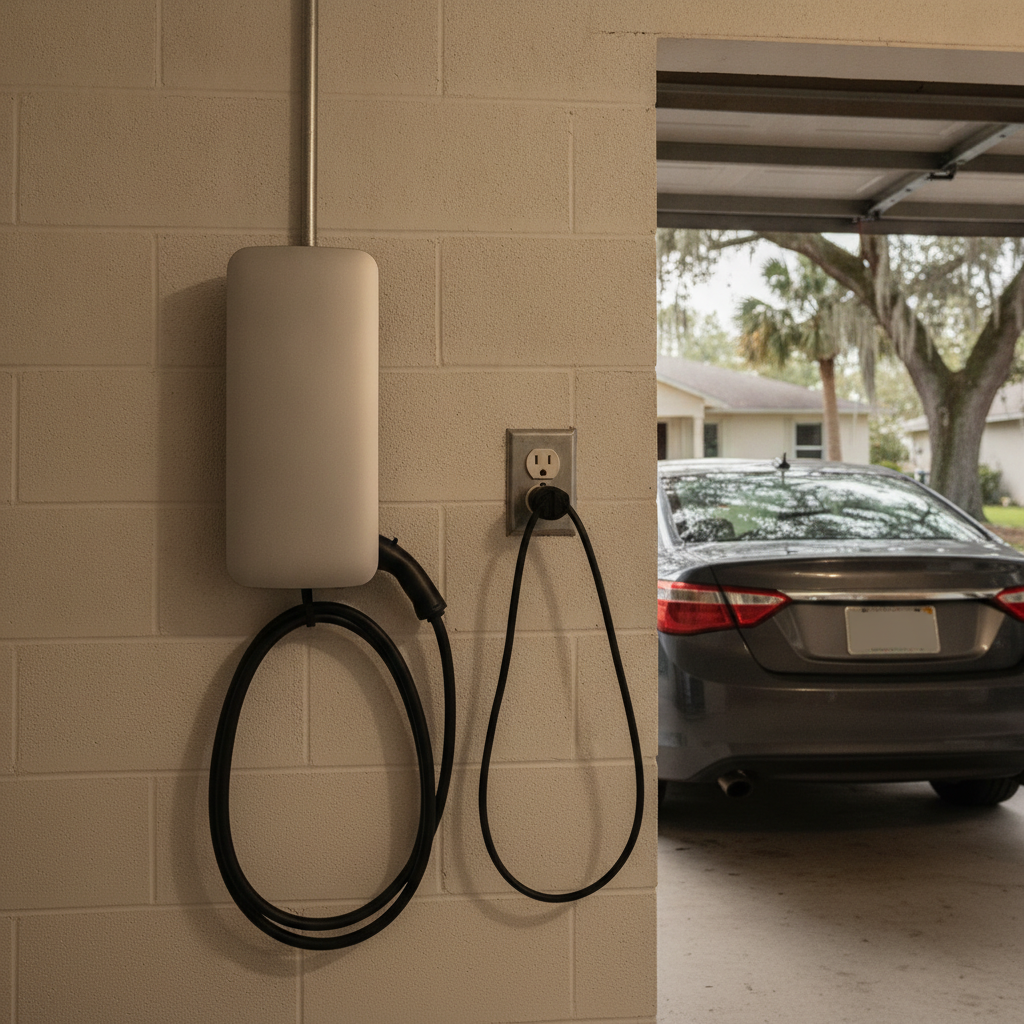
Hardwiring and plugging in are both ordinary ways to land a Level 2 charger, and the choice changes which rule the inspector reads. A plug-in charger needs a receptacle, usually a four-slot 50-amp NEMA 14-50R, and a receptacle in a dwelling garage or outdoors carries a ground-fault protection requirement. A hardwired unit has no receptacle, so that particular rule is not the one governing the connection; the equipment’s own listing and installation instructions are. Everything else, the circuit, the panel, the permit, is the same job either way. Homeowners in Tampa and across Hillsborough, Pinellas, and Pasco are usually deciding this after the charger is already in the box.
The receptacle is what pulls in the GFCI rule
NEC 210.8(A) in the 2020 edition reads that “all 125-volt through 250-volt receptacles installed in the locations specified in 210.8(A)(1) through (A)(11) and supplied by single-phase branch circuits rated 150 volts or less to ground shall have ground-fault circuit-interrupter protection for personnel.” That qualifier about single-phase branch circuits rated 150 volts or less to ground travels with the rule and is part of it. Location (2) on that list is garages along with accessory buildings at or below grade. Location (3) is outdoors. For dwelling units there is no amperage cap in that subsection, so a 50-amp receptacle on a garage wall is not exempt because it is large.
Florida is reading that edition. The Florida Building Code, 8th Edition (2023) adopts the 2020 National Electrical Code, which Miami-Dade County’s own published training material on the 8th Edition electrical changes states outright for its inspectors. The 9th Edition takes effect December 31, 2026, so anything an electrician pulls a permit for today is being inspected against the 8th.
The practical consequence sits in the panel, not on the garage wall. Protecting that receptacle means either a GFCI breaker feeding the circuit or a device that provides the protection, and the electrician sizes and selects that as part of the circuit design. A hardwired charger is permanently connected equipment rather than a receptacle, so 210.8(A) is not what the inspector checks it against. That does not mean ground-fault protection disappears from the conversation: the manufacturer’s instructions for the unit are enforceable, and they tell the electrician what the connection requires.
What a plug-in connection actually buys you
Flexibility, mostly, and it is real. A cord-and-plug charger comes off the wall. The homeowner who swaps the unit after a warranty claim, moves to Riverview in three years, or wants to try a different brand can unplug it and carry it. A dead charger on a hardwired circuit waits on an electrician before the replacement goes up. A dead charger on a receptacle waits on a box being delivered.
The receptacle is also hardware that can wear. EV charging is a continuous load, which means the circuit sits near its rating for hours at a stretch rather than cycling the way a range does. A 14-50R in a garage was designed for an occasional plug, not a nightly one, and a loose or poorly made connection behind the faceplate runs hot. Heat discoloration around the slots or a plug that no longer sits tight is a reason to have the connection looked at rather than to keep charging through it. An existing 14-50 in a garage is not proof of a suitable circuit either. The plug fitting says nothing about the conductor behind the wall, the breaker ahead of it, or whether anything else shares the run. Our 240-volt outlet guide walks through what the receptacle pattern does and does not tell you.
What hardwiring buys you
One fewer connection to fail. There is no plug, no cord cap, and no faceplate between the branch circuit and the charger, which matters more than it sounds when the equipment is drawing continuously in a closed Florida garage in August. Some chargers are listed only for permanent connection, and when the manufacturer’s instructions say hardwired, that is the installation, not a preference. Instructions that specify a permanent connection are enforceable the same way the code text is.
Hardwiring also takes the decision off the wall in a spot where a cord would be awkward. A carport in Apollo Beach, a detached Odessa garage at the end of a long run, a pedestal next to a driveway: those are placements where a permanently connected unit is the cleaner answer and where an outdoor receptacle would need a weather-rated enclosure, in-use cover, and a plug sitting exposed to Gulf-coast humidity and the afternoon storm that comes with it.
| Decision point | Plug-in | Hardwired |
|---|---|---|
| Code rule in play | The garage and outdoor receptacle requirement in 210.8(A) applies | Governed by the equipment’s listing and installation instructions |
| Swapping the unit | The homeowner unplugs it | Licensed work to disconnect and reconnect |
| Connection points | Branch circuit, receptacle, plug, cord cap | Branch circuit to equipment terminals |
| Outdoor placement | Needs a weather-rated enclosure and in-use cover | No receptacle to weatherproof |
| Set by the manufacturer | Allowed only if the unit is listed for cord-and-plug use | Required when the instructions say permanent connection |
The circuit, not the connector, is where the money is
Whichever end the electrician lands, the work ahead of it is identical: a breaker in the panel, a conductor sized for a continuous load, and a route from the panel to where the car parks. That route is most of the labor. A charger on the garage wall directly behind the panel is a short pull. The same charger on the far side of a block house, with the panel out at the meter and conduit going around the exterior, is a different job with the same box on the wall.
Capacity is the question before any of it. A load calculation under NEC 220.87 tells the electrician whether the existing service can carry the added continuous load, and a spare breaker space does not answer that. Circuit space and service capacity are two different problems: a subpanel can create spaces without adding a single amp of capacity. When the calculation comes back short, the conversation becomes a panel upgrade or a load-management plan, and our note on preparing an electrical panel for an EV charger covers how that assessment runs. A smart charger with an app is not by itself a load-management system.
This site publishes $1,200 to $2,000 for an EV charger installation where the panel already has adequate capacity. That is a published range, not a quote and not a Tampa average, and the connection method is rarely what moves it. Distance, wall construction, whether the run goes through conditioned space or around the outside, and any panel work are what move it. The full breakdown sits in our EV charger cost guide.
Permits and inspection work the same for both
A new 240-volt branch circuit is permitted electrical work in this metro, and the connection method does not change that. Hillsborough County’s list of work exempt from permits carries exactly one electrical exemption, for low-voltage work in an existing single-family residence under a $5,000 labor-and-materials cap. A 240-volt charger circuit is not low-voltage work and is not covered by it. Pinellas also requires a permit for work that changes a home’s electrical system. Florida’s 2026 permit-exemption law, which lets a single-family owner request an exemption for small-value work, specifically does not reach electrical work at any value.
Permit fees in Hillsborough and Pinellas generally run $75 to $150 depending on the municipality, and the reviewing authority is the one that covers the parcel rather than the city on the mailing address. City of Tampa, unincorporated Hillsborough, Largo, and Clearwater each run their own counter. An HOA or condo association can add its own approval on top of that, and in a townhome or a shared garage that approval often decides the mounting location before the electrician ever sizes a conductor.
Frequently asked questions
Do hardwired EV chargers need GFCI protection?
The receptacle rule in 210.8(A) is written about receptacles, so a permanently connected charger is not what that subsection governs. The equipment’s listing and its installation instructions are what the electrician and the inspector work from, and those instructions are enforceable. Many Level 2 units include their own ground-fault sensing internally as part of that listing. The short version: hardwiring takes the receptacle rule off the table, it does not take ground-fault protection off the table.
Can I plug a Level 2 charger into an existing dryer or range outlet?
Not on the assumption that the plug fits. A 14-50R is used for four-wire range circuits and for some charging equipment, and the pattern alone says nothing about the conductor, the breaker, the condition of the terminations, or what else shares that circuit. Charging is a continuous load and a range is not, so a circuit that has served a range for twenty years is not automatically sized for a charger running six hours a night. The electrician evaluates the existing circuit before anything gets plugged into it. A GFCI outlet installation or a protected breaker may also be part of bringing an older garage receptacle up to what the current rule requires.
Which option is faster to install?
Neither one meaningfully, because the branch circuit is the job. Pulling the conductor from the panel to the charger location is the work that takes the day, and that is identical whether the far end terminates in a receptacle or in the charger’s own terminals. Access decides the schedule: an unfinished garage ceiling, a block wall that needs surface conduit, or a Hyde Park plaster ceiling are three different afternoons.
When to call us
Sizing a charger circuit, running it, and connecting it at either end is licensed electrical work that gets permitted and inspected, and the load calculation behind it is the part a homeowner cannot do from the panel label. Tampa Electrical Pro matches homeowners across Hillsborough, Pinellas, and Pasco with independent licensed and insured electricians for EV charger installation. Call us at (813) 850-0320.